For a Kenyan law firm or accounting practice, the website does one job above all others: build enough trust in the first 30 seconds that a potential client sends an inquiry. In Kenyan professional services, trust is everything, clients are sharing sensitive legal or financial situations with a firm they may never have met.
A website that communicates professional credentials, regulatory compliance, and genuine expertise closes that trust gap before the first meeting.
Kenyan clients choose a law firm or accounting practice based on seven specific signals on the website
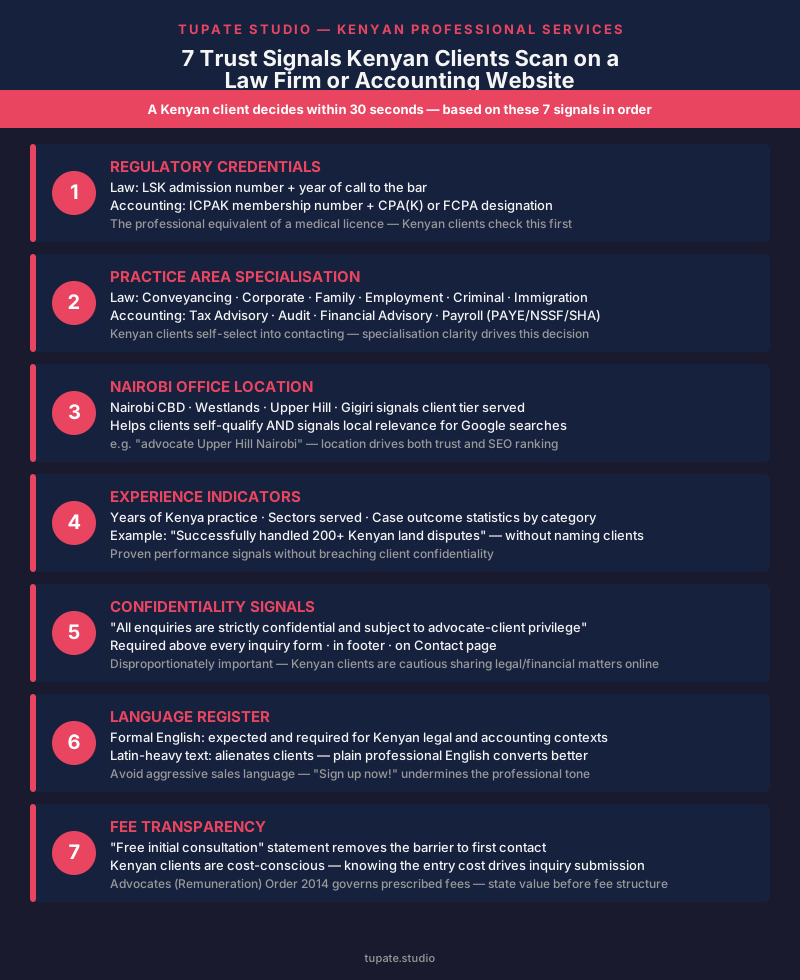
A Kenyan professional services client deciding between two firms does not read every word on the website, they scan for specific trust signals. Understanding those signals is the foundation of every law firm and accountancy website Tupate Studio builds.
The first signal is regulatory credentials. For advocates, Kenyan clients look for Law Society of Kenya (LSK) admission numbers and year of call to the bar, these are the professional equivalent of a medical licence for a doctor.
For accountants, the Institute of Certified Public Accountants of Kenya (ICPAK) membership number and CPA(K) or FCPA designation serve the same function. A Kenyan client seeing these credentials on a firm's website immediately knows the firm is operating legally and professionally.
The second signal is specialization. A Kenyan client with a property dispute wants a firm that explicitly handles conveyancing and property law, not a firm that lists "general legal services." Practice area clarity is not just good web design; it is the primary way Kenyan clients self-select into contacting a firm.
The same applies to accounting: a Kenyan SME looking for KRA tax advisory wants to see "Tax Advisory" listed as a dedicated service, not assumed under "accounting services."
Office location matters significantly in Kenya's professional services market. A Nairobi CBD address, a Westlands office, or an Upper Hill location each signals the tier of clients the firm typically serves.
This helps potential clients self-qualify, and it tells Google the firm's local relevance for searches like "advocate Upper Hill Nairobi."
Experience indicators, years of practice in Kenya, sectors served, and case outcomes by category (e.g., "successfully handled 200+ Kenyan land disputes"), give Kenyan clients the reassurance of proven performance without naming individual clients.
Confidentiality signals are disproportionately important for Kenyan professional services. Kenyan clients are culturally cautious about sharing legal or financial situations with an unknown firm online.
An explicit confidentiality statement before every inquiry form ("All enquiries are strictly confidential") directly addresses this hesitation and increases inquiry submission rates.
Language register matters: formal English is expected in Kenyan legal and accounting contexts, but Latin-heavy text alienates clients. Plain, professional English converts better.
Finally, fee transparency, even a "Free initial consultation" statement, drives inquiry. Kenyan clients are cost-conscious; knowing the entry cost removes a barrier to contact. Tupate Studio builds every professional services website to communicate all seven of these signals clearly and credibly.
Practice area pages are the SEO backbone of every Kenyan law firm website, each major area needs its own dedicated, fully optimised page
A single "Our Services" page listing ten practice areas does not rank for any of them. Google indexes individual pages, meaning a Kenyan law firm that wants to appear when someone searches "family law advocate Nairobi" needs a page specifically about family law in Kenya.
Tupate Studio structures Kenyan law firm websites with individual practice area pages, each built to rank for its specific query cluster.
For Kenyan law firms, the core practice area pages are:
Conveyancing and Property Law: Land transactions in Kenya involve the ARDHI SASA system for title searches, the Land Registration Act 2012, and land title transfers processed through county land offices. A practice area page covering the full Kenyan conveyancing process, from offer to completion, stamp duty calculation, and title registration, ranks for queries like "conveyancing lawyer Nairobi" and "land title transfer Kenya."
Corporate Law: Company incorporation under the Kenya Companies Act 2015, shareholders agreements, mergers and acquisitions, and commercial contracts. Kenyan entrepreneurs incorporating new businesses search specifically for "company registration advocate Kenya", a dedicated corporate law page captures this query.
Family Law: Divorce proceedings under the Matrimonial Property Act 2013, custody arrangements, child maintenance, and adoption. Kenyan family law queries are high-volume and emotionally driven, a page written with empathy and clarity for Kenyan families converts significantly better than a generic "family law" listing.
Employment Law: The Employment Act 2007, unfair dismissal claims, redundancy processes, COTU arbitration, and representation at the Employment and Labour Relations Court. Growing demand from Kenyan employers and employees navigating retrenchment and contract disputes.
Criminal Defence: Bail applications, plea bargaining, and High Court of Kenya representation. Queries come from families of accused persons, the page must be clear, non-judgmental, and action-oriented.
Immigration Law: Work permits, investor visas, and citizenship applications under the Kenya Citizenship and Immigration Act. Growing demand from international companies setting up in Kenya and from Kenyan diaspora members returning.
For Kenyan accounting practices, the core service pages are: Audit and Assurance (IFRS compliance, ISA standards, KRA audit support), Tax Advisory (VAT returns, corporate tax, transfer pricing, withholding tax), Financial Advisory (business valuation, CFO services for Kenyan SMEs), and Payroll Management (PAYE, NSSF, SHA/NHIF statutory deductions). Each page on a Tupate Studio-built site includes a confidential inquiry form and a clear statement of the firm's experience in that specific area.
Advocate and CPA profile pages communicate personal credibility, LSK and ICPAK credentials are the anchor of every professional profile
In Kenya's professional services market, clients hire people as much as they hire firms. An advocate or CPA profile page is the moment a potential client moves from considering a firm to deciding on it. These pages must be built with precision, not as generic biographical blurbs, but as structured credibility declarations.
Every advocate profile page on a Tupate Studio-built Kenyan law firm website includes: the advocate's full name with their title (Advocate of the High Court of Kenya), their LSK admission number and year of call to the bar, their law school (University of Nairobi, Strathmore University Law School, Moi University, Mount Kenya University, or overseas institution), and any postgraduate qualifications such as an LLM. Practice areas and years of Kenyan practice experience are listed explicitly. Notable achievements are described by outcome category, "Successfully resolved 50+ High Court commercial disputes", without naming individual clients.
Professional memberships including LSK, the East African Law Society, and ICC Kenya chapter are displayed. Where advocates have published articles or delivered professional talks, these are listed to reinforce thought leadership.
For CPA and accounting firm profiles, the equivalent elements are: ICPAK membership number and grade (CPA(K) for practicing members, FCPA for fellows), audit firm practising certificate number (required for any CPA firm offering statutory audit services in Kenya), and previous Big4 or top-tier firm experience if applicable, this is a significant credibility signal in Kenya's accounting market, where firms like Deloitte, KPMG, PwC, and EY have name recognition.
A practical consideration: senior partners at Kenyan law and accounting firms often prefer not to display personal mobile numbers on their website. Tupate Studio structures these profiles with the firm's switchboard number and a direct inquiry form, maintaining privacy while keeping the contact pathway clear.
Profile photos must be professional: formal business attire, neutral background, appropriate for Kenya's legal and financial professional culture. The profile photo is often the first impression a potential Kenyan client has of the person they are about to trust with a sensitive legal or financial matter.
Confidentiality architecture and specific trust signals are what convert Kenyan legal and accounting website visitors into inquiry submissions
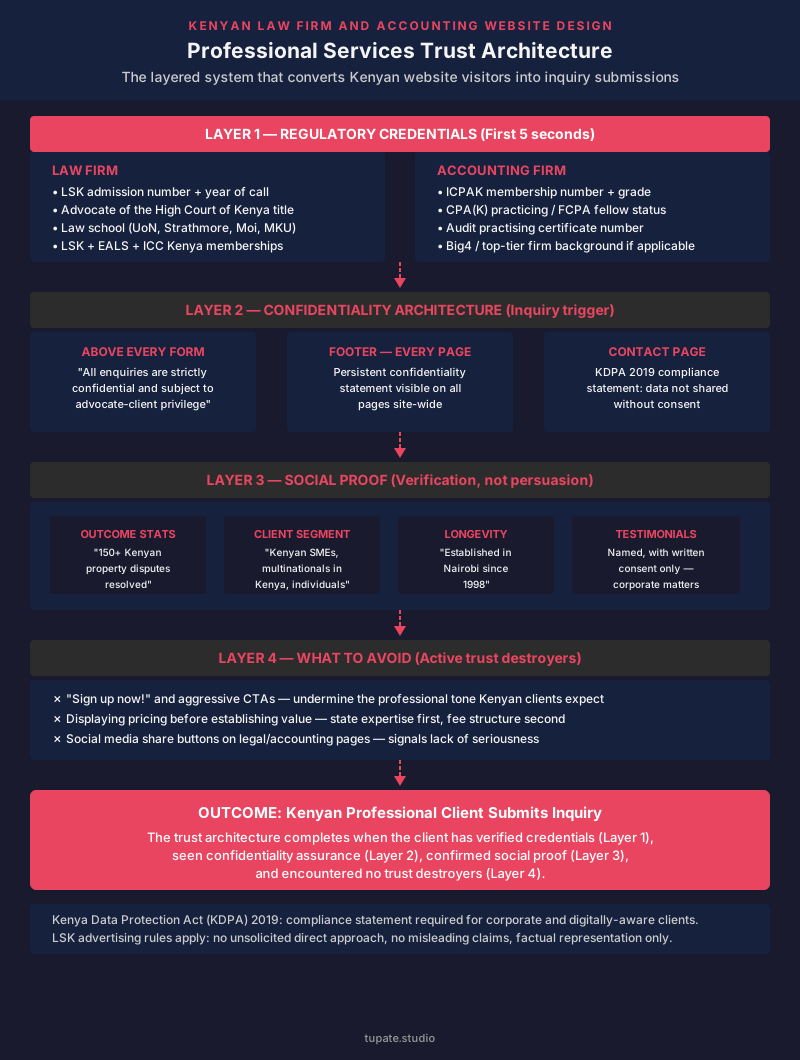
The single biggest conversion failure on Kenyan professional services websites is the absence of explicit confidentiality assurance. Kenyan clients, particularly those dealing with divorce, criminal matters, tax disputes, or business insolvency, are sharing some of the most sensitive information in their lives.
A website that asks them to fill in a form without addressing confidentiality first loses those inquiries to competitors who do.
Tupate Studio places confidentiality statements in three mandatory locations on every Kenyan law firm and accounting practice website: immediately above every inquiry form ("All enquiries are strictly confidential and subject to advocate-client privilege"), in the website footer on every page, and on the Contact page. For accounting firms, the equivalent statement is: "All financial information shared with our firm is handled under professional confidentiality obligations and ICPAK ethical standards."
Kenya Data Protection Act (KDPA) 2019 compliance statements are a growing trust signal for digitally aware Kenyan clients, particularly businesses and corporates. A brief statement confirming that submitted data is handled in accordance with the KDPA and will not be shared with third parties without consent removes a specific concern that sophisticated Kenyan clients have about submitting information online.
Social proof on Kenyan professional services websites works through specific, verifiable claims rather than generic praise. The formats that work: outcome statistics by category ("Successfully resolved 150+ Kenyan property disputes"), client segment statements ("We serve Kenyan SMEs, multinationals operating in Kenya, and individual Kenyan clients"), establishment longevity ("Established in Nairobi since 1998"), and named testimonials where the client has given explicit written consent, some Kenyan clients in commercial and corporate matters will consent to being quoted.
There are specific elements to avoid on a Kenyan legal or accounting website: aggressive sales language ("Sign up now!") undermines the professional tone. Displaying pricing before establishing value causes early exit, state the value first, then the fee structure.
Social media share buttons on legal and accounting pages signal a lack of seriousness that Kenyan professional clients notice.
Every Tupate Studio professional services website is built with this specific Kenyan client psychology embedded in the design, from form placement to confidentiality language to the sequencing of trust signals.
Accounting firm websites in Kenya require ICPAK credentials, KRA compliance pages, and digital accounting tool declarations to convert the right clients
Kenyan accounting firm websites have distinct requirements that differ from general business websites and from law firm websites. Tupate Studio builds accounting firm sites with the following specific elements that Kenyan accounting clients look for before making contact.
ICPAK display is mandatory: the ICPAK membership logo and the firm's membership number must appear on the homepage, the footer on every page, and the About page. This is the accounting equivalent of the LSK badge for advocates, Kenyan businesses and individuals verifying a firm's legitimacy check for ICPAK registration first.
Accounting standards declaration: a Kenyan accounting firm's website should state which standards it applies. Government and parastatal clients require IPSAS (International Public Sector Accounting Standards) compliance.
Private sector Kenyan clients require IFRS. Mixed-practice firms should state both and clarify which applies to which service line, this specificity signals expertise to Kenyan public sector procurement officers who shortlist accounting firms by IPSAS competence.
KRA compliance services are the highest-search-volume accounting category in Kenya. A dedicated KRA compliance service page covering VAT returns, income tax returns, corporate tax, withholding tax, and PAYE processing ranks for queries that Kenyan businesses search daily, particularly during KRA filing periods.
This page drives more organic inquiries than any other accounting service page in Kenya.
Audit service pages must display the firm's ICPAK practising certificate number, audit firms in Kenya must hold a practising certificate, and sophisticated Kenyan audit clients verify this before engagement.
Forensic accounting is a growing service category in Kenya: county government audits, fraud investigations for Kenyan corporates, and regulatory investigations. A dedicated forensic accounting page positions the firm for this higher-value work.
AGPO (Access to Government Procurement Opportunities) registration is relevant for Kenyan SME accounting firms targeting county government contracts, stating AGPO certification on the website opens this market.
Digital accounting tool support: listing the platforms the firm works with, QuickBooks Kenya, Sage, Xero, Odoo, is a practical conversion signal for Kenyan SMEs who want an accountant fluent in their existing software. Tupate Studio includes this in every Kenyan accounting firm's services section.
Thought leadership content builds long-term search visibility and pre-qualifies Kenyan legal and accounting clients before they contact the firm
Kenyan professionals and business owners research their legal and financial situations online before engaging any professional. The firm that provides that educational content, the clear, authoritative guide to the Kenyan legal or accounting process, earns the trust before the first conversation.
This is why thought leadership content is a strategic investment for Kenyan law and accounting firms, not an optional extra.
For Kenyan law firms, the highest-traffic informational queries are well-established: "how to transfer land title in Kenya," "rights of employees in Kenya," "how to incorporate a company in Kenya," "divorce process in Kenya," "what is a shareholders agreement Kenya." These are queries asked by thousands of Kenyans every month who are at the early stage of a legal process and have not yet chosen a firm. A comprehensive guide on your firm's website ranking for these queries delivers pre-educated, pre-qualified inquiries.
For Kenyan accounting firms, the equivalent queries include: "how to file KRA returns," "VAT registration Kenya," "PAYE calculation Kenya," "annual returns Companies Act Kenya," "corporate tax rate Kenya 2025." These are asked by Kenyan business owners and finance managers who need information and are simultaneously considering engaging an accountant.
The format that works for Kenyan professional services thought leadership is authoritative, well-structured guides of 1,500–3,000 words, not brief blog posts. Each guide covers the Kenyan legal or financial topic completely, references the relevant Kenyan statute or KRA regulation, and concludes with a clear statement: "This is general information, not legal/financial advice, contact [firm name] for specific guidance on your situation." This disclaimer is a standard practice in Kenyan professional services content and protects the firm from inadvertent liability while maintaining approachability.
A content strategy for Kenyan websites built on this foundation — 1–2 authoritative pieces per month, compounds significantly over 12–24 months of publication.
Tupate Studio builds Kenyan professional services websites with the content architecture to support this thought leadership strategy: structured blog sections, schema markup for articles, and internal linking from guides back to practice area pages.
A professionally built website is the foundation, but it only generates inquiries if potential clients can find it. For a Nairobi law firm or accounting practice, SEO Services in Kenya determines whether your practice area pages appear when Kenyan clients search for "family law advocate Nairobi" or "KRA tax adviser Kenya." And for firms whose clients are concentrated in specific areas, Upper Hill, Westlands, Gigiri, local SEO for law firms Kenya ensures your firm appears in Google Maps and the local pack when proximity-based searches are made.
Larger firms with a complex stakeholder audience, investors, partners, and enterprise clients, may benefit from reviewing our corporate website for Kenyan businesses guide, which addresses the additional structural requirements of multi-audience sites. Visibility and credibility work together: without both, the website under-performs.
Legal and accounting website design FAQs for Kenyan firms, answered directly
Frequently Asked Questions
Should a Kenyan law firm display fee rates on its website?
Kenyan law firms are guided by the Advocates (Remuneration) Order 2014 for prescribed fees. For non-prescribed matters, transparent fee structures, for example, "Consultations from Ksh 5,000", can be displayed. They attract cost-conscious Kenyan clients while setting expectations before the first call. Most Nairobi firms prefer "contact for fee quotation" to retain negotiation flexibility on complex matters. Tupate Studio advises on the fee disclosure approach that suits each firm's positioning and client base.
How important is a Kenyan accounting firm's website versus referrals?
Referrals remain the primary source of new accounting clients in Kenya. However, when a referred client receives a firm's name, the first action they take is a Google search. A professional website converts that search into a confirmed engagement, firms without websites, or with outdated websites, lose referred clients who cannot verify legitimacy online. The website does not replace referrals; it converts them at a higher rate.
Can Tupate Studio design a law firm website that complies with LSK advertising rules?
Yes. Tupate Studio is aware of the Advocates Act restrictions on legal advertising in Kenya. Our law firm website designs comply with LSK guidelines: no unsolicited direct approach, no misleading claims, factual representation of services and credentials only. We build websites that communicate the firm's expertise and credentials professionally without violating the professional conduct rules that Kenyan advocates are bound by. WhatsApp us to discuss your specific firm's requirements.