A Kenyan business website that nobody is actively maintaining is a liability, not an asset. Within 6 to 18 months of launch with no maintenance, the average WordPress website in Kenya will experience at least one security breach, one serious performance degradation, or one critical broken feature, a contact form that silently fails, a checkout that stops processing M-Pesa payments, or a homepage replaced overnight by hacker spam. Website maintenance is not optional for a Kenyan business that depends on its website for leads, orders, or credibility.
It is the ongoing cost of owning a professional digital presence. Tupate Studio provides monthly website maintenance for Kenyan businesses at Ksh 5,000 per month, so your website stays online, secure, and performing while you focus on running your business.
Website maintenance covers your Kenyan business website across six active dimensions, not just text changes.
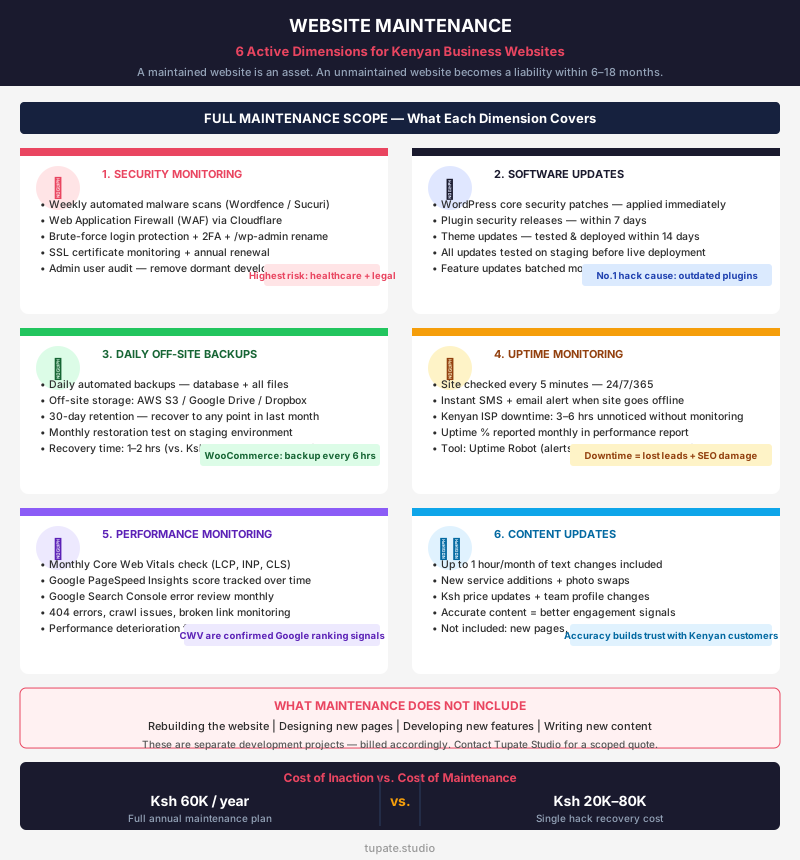
Many Kenyan business owners believe website maintenance means updating a phone number or swapping a photo. That misunderstanding is why so many Kenyan websites are hacked, slow, or broken. Full website maintenance for a Kenyan business covers every layer of your website's health.
Security monitoring includes weekly automated malware scans of all website files for known malware signatures, active firewall rules (WAF, Web Application Firewall) to block malicious traffic before it reaches your server, SSL certificate monitoring and renewal (your HTTPS padlock), brute-force login protection, and file integrity monitoring that alerts when critical website files change unexpectedly.
Software updates cover your CMS core (WordPress), all installed themes, and every plugin. Outdated WordPress plugins are the number-one cause of Kenyan website hacks in 2024 and 2025 — automated bots scan millions of sites daily looking for known vulnerabilities in specific plugin versions. Updates are tested on a staging environment before being applied to your live site, so a plugin conflict never takes your website down unannounced.
Backups run daily and automatically, storing copies off-site, on AWS S3, Google Drive, or Dropbox, completely separate from your hosting server. If your hosting server fails, your backup is not lost with it. We retain 30 days of daily backups and test restoration monthly, because many Kenyan businesses discover their backup files are corrupted only at the moment they need them most.
Uptime monitoring checks your website every 5 minutes, 24 hours a day. When your site goes offline, due to a hosting issue, a plugin conflict, or a Kenyan ISP outage, you receive an instant SMS and email alert. Kenyan ISP downtime patterns mean a Nairobi business website can go offline for 3 to 6 hours completely unnoticed without active monitoring.
Performance monitoring tracks your Core Web Vitals scores and Google PageSpeed Insights results monthly, flagging deterioration before it affects your Google rankings.
Content updates cover up to one hour per month of text changes, new service additions, photo swaps, and Ksh price updates, keeping your website accurate for Kenyan customers.
What maintenance does NOT include: rebuilding the website, designing new pages, developing new features, or writing new content. Those are separate development projects billed accordingly.
When the maintenance scope is no longer sufficient, for example when the site's structure, design, or technology is outdated, website modernisation Kenya is the appropriate next step. Tupate Studio builds and maintains custom-coded Kenyan business websites that stay healthy, secure, and online.
Delaying WordPress plugin and theme updates puts your Kenyan business website at direct risk of being hacked within weeks.
WordPress powers 43% of all websites globally, which makes every WordPress installation a target for the automated hacking scripts that scan the web continuously. These bots do not target your business specifically.
They target the version numbers of vulnerable plugins. If your Kenyan business website runs an outdated version of Contact Form 7, WooCommerce, Elementor, or Yoast SEO, all extremely common on Kenyan WordPress sites, your website is in that bot's list.
Kenyan WordPress sites are scanned by these bots constantly. When a new vulnerability is published for a popular plugin (this happens dozens of times per year), mass exploitation begins within 24 to 72 hours of the announcement. Businesses that have not applied the security patch within that window are compromised at scale.
The consequences for a Kenyan business website that gets hacked are severe: website defacement (hackers replace your homepage with political messaging, competitor spam, or Arabic-language gambling content), malicious redirects (your Kenyan customers click your Google search result and land on a spam site), data theft (if your website stores customer names, phone numbers, or M-Pesa transaction records), and Google Safe Browsing penalties (Chrome blocks your website with a full-screen red warning page, your visitors see "This site may harm your computer" and almost all of them leave immediately, permanently).
Professional update management does not mean applying every update the moment it releases. Theme updates can break custom design elements. Plugin updates can conflict with each other.
The correct approach is to test every update on a staging copy of your website, verify nothing breaks, then deploy to the live site. This is what Tupate Studio does for every website on our maintenance plan.
Update frequency standards: WordPress core security releases, applied immediately. Plugin security releases, within 7 days. Theme updates, tested and deployed within 14 days.
Feature-only plugin updates (no security component), batched monthly after staging verification. This schedule keeps your Kenyan website protected without introducing instability from rushed updates.
A technical SEO audit Kenya will surface any existing outdated plugins or known vulnerabilities on your current website before you onboard to a maintenance plan.
Security monitoring protects your Kenyan business website from the automated attacks targeting it right now.
Healthcare, legal, and financial Kenyan business websites are the highest-value targets because they hold client data, names, ID numbers, medical records, financial information. But every Kenyan business website faces automated bot attacks daily, regardless of size or industry.
A small Nairobi plumbing company website receives bot traffic attempting login exploits the same day it launches.
Malware scanning runs automated weekly scans of every file on your website against databases of known malware signatures. Tools like Wordfence, Sucuri, and Malcure are used for WordPress sites. Any suspicious file changes trigger immediate alerts.
Web Application Firewall (WAF) blocks malicious requests before they reach your website. Cloudflare's free tier provides basic WAF protection for Kenyan websites and blocks the majority of automated attack traffic at the network edge, before it even touches your hosting server.
Login security hardening is critical because the WordPress admin login page (/wp-admin) is the primary attack vector. Proper security implements two-factor authentication (2FA), limits login attempts (blocking an IP address after 3 failed attempts), and renames the /wp-admin URL to something non-standard. These three changes eliminate the vast majority of brute-force login attacks against Kenyan business websites.
SSL certificate monitoring ensures your HTTPS padlock never expires. Google Chrome displays a "Not Secure" warning for HTTP pages, Kenyan visitors see this and immediately distrust your business. SSL certificates require annual renewal. Many Kenyan websites have lapsed SSL because no one was monitoring the renewal date.
Admin user audit removes unnecessary privileged accounts. Most Kenyan business websites have admin accounts from previous developers who no longer work on the site, each dormant admin account is an unused attack surface. Regular audit identifies and removes accounts that do not need to exist.
Tupate Studio builds custom-coded Kenyan websites with a significantly smaller attack surface than WordPress, no public plugin CVE database, no theme vulnerabilities, no CMS exploit history. For existing WordPress sites on our maintenance plan, security hardening is applied during onboarding.
Daily off-site backups give your Kenyan business website a guaranteed recovery path from any failure scenario.
The most common moment a Kenyan business owner discovers they have no working backup is 3 hours after their website has been hacked and defaced. Their hosting provider offers a backup, but it is stored on the same server that was compromised, is seven days old, and turns out to be a corrupted file.
This scenario happens to Kenyan businesses every week.
Backup frequency
daily automated backups for active Kenyan business websites. Low-update static sites receive a minimum of weekly backups. Websites with active WooCommerce stores or frequently updated product catalogs should back up every 6 hours to minimize order data loss in a recovery scenario.
What gets backed up
the complete database (all your content, customer orders, form submissions, and settings) AND all files (themes, plugins, uploaded photos, and documents). A database backup without files, or files without a database, cannot restore a functioning website.
Off-site storage
backups are stored on a completely separate infrastructure from your hosting server. Tupate Studio uses AWS S3, Google Drive, or Dropbox depending on your backup volume and preference. When a hosting server fails, including catastrophic failures where the server is permanently offline, your backups are intact and accessible.
30-day retention
we keep 30 days of daily backups. This allows recovery to any point within the last month. If a subtle database corruption went unnoticed for two weeks, we can recover to a clean version from before the issue began.
Monthly restoration testing
every month we perform a test restoration of your backup onto a staging environment and verify the site loads correctly. A backup that has never been tested is not a backup, it is a file that might restore your site.
Most cheap Kenyan shared hosting "backup" features are weekly snapshots stored on the same server, inadequate for any business-critical website.
With proper off-site backups, a hacked or crashed Kenyan business website is fully restored within 1 to 2 hours of notification. Without backups, recovery requires rebuilding from scratch, a cost of Ksh 15,000 to 50,000 in developer fees plus days of business disruption.
The Tupate Studio website maintenance plan covers everything your Kenyan business website needs for Ksh 5,000 per month.

The Tupate Studio monthly website maintenance plan is designed for Kenyan businesses that cannot afford downtime, hacks, or broken features, and do not have an in-house developer to manage their website's health.
What is included every month:
- All WordPress core, theme, and plugin updates, tested on staging before deployment to live site
- Weekly automated malware scans with alert and remediation
- Daily automated backups with 30-day retention, stored off-site (not on your hosting server)
- Uptime monitoring every 5 minutes with instant SMS alert when site goes offline
- Monthly Core Web Vitals and Google PageSpeed Insights check, performance tracked over time
- Monthly Google Search Console error review — 404 errors, crawl issues, and broken link monitoring
- Up to 1 hour of content changes per month: text updates, new photos, service additions, Ksh price changes
- Monthly performance report: uptime percentage, page speed score, security status, updates applied
What is not included
new page design, new website features, SEO strategy, content writing, and Google Ads management. These are billed as separate projects. If you need SEO growth alongside maintenance, see our SEO Services in Kenya retainer, which runs at Ksh 8,000 per month.
Contract terms
month-to-month, cancel anytime via WhatsApp with 7 days' notice before the next billing date. No annual contract, no cancellation penalty.
Onboarding process
Tupate Studio requests your website admin access and hosting control panel access, performs an initial security and technical audit, remediates any existing issues found, sets up all monitoring tools, and configures off-site backup storage. Setup time: 1 to 2 business days.
For websites built by other developers, a one-time onboarding audit fee of Ksh 3,500 applies.
Value comparison
Ksh 5,000 per month equals Ksh 60,000 per year. A single WordPress hack recovery for a Kenyan business, cleanup, security hardening, Google Safe Browsing review submission, and reputational recovery, typically costs Ksh 20,000 to Ksh 80,000 in developer fees, plus revenue lost during the hours or days the site is down or flagged.
One prevented incident pays for the maintenance plan multiple times over.
WhatsApp us today to add your Kenyan business website to the Tupate Studio maintenance plan, or get a free quote if you need a custom scope assessed first.
Website maintenance keeps your Kenyan business website healthy, secure, and online, but it does not improve your Google rankings. SEO is a continuous process: monitoring search performance in Google Search Console, updating content for changed Kenyan search patterns, building new content nodes to expand topical coverage, and earning signals that tell Google your website deserves to rank higher.
Tupate Studio's SEO Services in Kenya retainer (Ksh 8,000 per month) complements website maintenance by actively growing your Kenyan website's visibility and organic traffic over time, turning a maintained website into a lead-generating asset.
Custom-built Kenyan business websites require significantly less maintenance overhead than WordPress sites.
WordPress maintenance requires 4 to 8 hours of active developer time per month when done properly: testing plugin updates for conflicts, monitoring the CVE vulnerability database, managing theme customization compatibility across core updates, and resolving the frequent permission errors and plugin conflicts that come with a plugin-dependent CMS architecture.
Tupate Studio builds custom-coded websites for Kenyan businesses, no plugins to update, no CMS core vulnerabilities, no publicly documented attack surface. Our custom-built sites do not appear in the WordPress CVE (Common Vulnerabilities and Exposures) database because they do not use WordPress.
Automated hacking bots targeting WordPress-specific vulnerabilities find nothing to exploit on a custom-built site.
For custom-built Tupate Studio websites, maintenance focuses entirely on security monitoring, off-site backups, uptime monitoring, and content updates, at the same Ksh 5,000 per month rate. Update cycles are controlled entirely by Tupate Studio: your website changes only when we deliberately update it, never due to an automatic CMS update that breaks something.
For businesses currently on WordPress considering a migration, see our comparison: custom-built website vs WordPress Kenya. For businesses starting fresh, read about our website design Kenya service, which defaults to custom-coded builds for all Tupate Studio clients.
Frequently Asked Questions: Website Maintenance for Kenyan Businesses
My website was built by someone else, can Tupate Studio maintain it?
Yes, Tupate Studio can take over maintenance of any existing Kenyan business website, including WordPress sites built by other developers. We perform an initial security and technical audit (Ksh 3,500 one-time fee), identify existing vulnerabilities and performance issues, then onboard the site to our monthly maintenance plan. Most external WordPress sites require security hardening during onboarding before standard monitoring and update management can begin.
Do I need website maintenance if my site does not change often?
Yes, even static Kenyan websites that never change need security monitoring, SSL certificate renewal, uptime monitoring, and backup management. A site that "never changes" is still vulnerable to security attacks and hosting failures. Low-traffic Kenyan websites are not ignored by hackers, they are specifically targeted by automated bots because their owners are unlikely to be monitoring them. Inactivity is not protection.
What happens if my website gets hacked while on the Tupate Studio maintenance plan?
Tupate Studio restores your website from the most recent clean backup within 4 to 8 hours of notification. We then investigate the entry point, patch the vulnerability, harden the site against recurrence, and submit a Google Safe Browsing review request to remove any security warnings from Chrome. Hack recovery is included in the maintenance plan for attacks via known WordPress vulnerabilities. Additional developer time may be billed for custom or novel attack vectors that require extensive forensic investigation.
Can I cancel the maintenance plan if I am not satisfied?
Yes, the Tupate Studio website maintenance plan is month-to-month with no contract lock-in. Cancel via WhatsApp at least 7 days before your next billing date and no further charges are applied. We will provide a final backup of your website and transfer all monitoring tool access to you or your next provider.