The Kenya Data Protection Act 2019 (KDPA) came into force on November 8, 2019, and applies to any organisation, Kenyan or international, that collects, processes, or stores personal data of Kenyan citizens. For Kenyan business websites, this means: if your website has a contact form, uses Google Analytics, collects email addresses, or stores customer data for M-Pesa orders, the KDPA applies to you and your website must comply.
Non-compliance carries fines of up to Ksh 5,000,000 from the Office of the Data Protection Commissioner.
What the Kenya Data Protection Act Covers
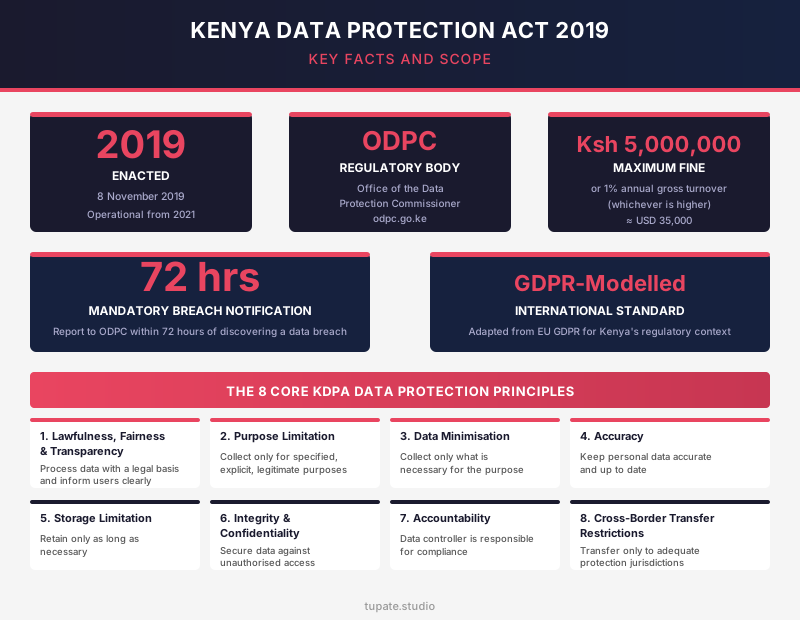
The Kenya Data Protection Act 2019 was enacted on November 8, 2019, making Kenya one of the first African countries to establish a comprehensive national framework for personal data protection. The Act is modelled significantly on the EU General Data Protection Regulation (GDPR), adapted for Kenya's regulatory context, economic structure, and existing legislation. Its scope is broad by design: the KDPA applies to any person or organisation that processes personal data in connection with activities carried out in Kenya, regardless of where that person or organisation is located.
A UK company with a Kenyan customer database is subject to KDPA. A Kenyan SME with a contact form is subject to KDPA.
The regulatory body established under the Act is the Office of the Data Protection Commissioner (ODPC Kenya), which became operational in 2021 and has been progressively expanding its enforcement activity since. The ODPC operates independently and has the authority to investigate complaints, conduct audits, issue enforcement notices, and impose administrative fines.
Under the KDPA, "personal data" means any information relating to an identified or identifiable natural person. For Kenyan business websites, this definition covers: full names and contact details submitted through contact forms; phone numbers including Safaricom M-Pesa registered numbers; email addresses collected for newsletters or order confirmations; location data from browsers; IP addresses captured by analytics tools including Google Analytics; and cookies placed on a user's device.
Any collection of these data types triggers KDPA obligations.
The Act distinguishes between ordinary personal data and sensitive personal data. Sensitive personal data, which includes health records, biometric data (fingerprints, facial recognition), racial or ethnic origin, financial data beyond basic contact, and criminal records, attracts a higher standard of protection and more stringent consent requirements.
Most Kenyan business websites handle ordinary personal data; websites in healthcare, financial services, or identity verification handle sensitive data and face more exacting obligations.
The eight core data protection principles under KDPA are: lawfulness, fairness, and transparency; purpose limitation (data collected only for specified, explicit purposes); data minimisation (collect only what is necessary); accuracy; storage limitation (retain only as long as necessary); integrity and confidentiality; accountability; and cross-border transfer restrictions. Every data processing activity on a Kenyan business website must be justifiable under at least one of these principles.
KDPA Website Compliance Requirements
The Privacy Policy page is the most visible and non-negotiable KDPA compliance element for a Kenyan business website. It must be published, accessible from every page (typically linked in the website footer), and kept current.
A compliant Privacy Policy for a Kenyan business website must state: what categories of personal data the website collects (names, email addresses, phone numbers from contact forms; IP addresses, cookies, and behavioural data from analytics tools); the specific purpose for each category of data collected (purpose limitation, vague statements like "improving our services" do not satisfy KDPA); how data is stored and what security measures protect it; whether any data is shared with or processed by third parties, naming them specifically (Google Analytics, WhatsApp Business API, payment processors, email marketing platforms); the data subject rights of Kenyan users under KDPA; full contact details of the Data Controller (the business itself); and the date the policy was last reviewed.
Cookie consent is required whenever a Kenyan business website uses non-essential cookies. Google Analytics 4 — used on the majority of Kenyan business websites to understand visitor behaviour, is classified as a non-essential cookie under KDPA. So are Google Ads conversion tracking pixels, Facebook Pixel for retargeting, TikTok Pixel, and LinkedIn Insight Tag. Website analytics Kenya implementations must be accompanied by a functional cookie consent banner.
This banner must present Kenyan users with a genuine choice: accept all cookies, reject non-essential cookies, or customise preferences by category. Pre-ticked boxes, where consent is assumed unless the user unticks, are invalid under KDPA. Consent must be active and affirmative. Essential cookies (login session management, shopping cart contents, security tokens) do not require consent as they are technically necessary for the website to function.
Contact forms on Kenyan business websites must include two elements beyond the data fields themselves: a clear statement explaining why the submitted data is being collected (for example: "Your name and email address will be used to respond to your enquiry. They will not be shared with third parties or used for marketing without your separate consent.") and a link to the website's Privacy Policy.
Forms may not collect more data than is necessary for their stated purpose, requiring a national ID number on a general enquiry form, for example, exceeds the data minimisation principle.
If a Kenyan business website uses third-party data processors, and virtually all do, through Google Analytics, Mailchimp for email, Zoho or HubSpot for CRM, or cloud hosting, the business must have Data Processing Agreements (DPAs) in place with each processor. Google, Mailchimp, HubSpot, and most major platforms provide standard DPAs that can be accepted through their account settings.
Kenyan businesses using local or regional processors (Kenyan SMS gateway providers, local CRM systems) must ensure written agreements are in place that specify the processor's obligations under KDPA.
ODPC Registration Requirements
The ODPC requires that data controllers and data processors operating in Kenya and processing personal data above certain thresholds register formally through the ODPC's online registration portal at odpc.go.ke. Registration is not optional for commercial businesses with significant customer data operations, the exemptions in the Act are narrow and apply primarily to individuals processing data for purely personal or household purposes.
A Kenyan business operating a website that collects customer contact information, processes M-Pesa payment data, or maintains a customer database for marketing communications is operating as a data controller and is generally required to register.
The registration process requires an organisation to provide: full entity details (registered business name, KRA PIN, physical address); a description of the categories of personal data processed and the purposes for which they are processed; details of any cross-border data transfers (relevant for businesses using cloud services hosted outside Kenya, such as US-based Google or Amazon AWS servers); a description of data security measures implemented; and, where applicable, the name and contact details of a designated Data Protection Officer (DPO). Small Kenyan businesses without a designated DPO typically list a senior responsible individual.
Registration fees with the ODPC vary by organisation category and size. For the 2024–2025 period, commercial entity registration fees range from Ksh 5,000 for smaller organisations to Ksh 50,000 or more for large enterprises processing extensive personal data.
Registration is annual, businesses must renew and update their registration if their data processing activities change materially. The ODPC's review and approval timeline is typically 30 to 60 days from a complete application submission.
Businesses that process personal data while unregistered, where registration is required, face enforcement risk from the ODPC in addition to the substantive compliance penalties described below. Early registration also creates a documented record of good-faith compliance effort, which is relevant to ODPC discretion in any subsequent enforcement action.
KDPA Penalties and Enforcement
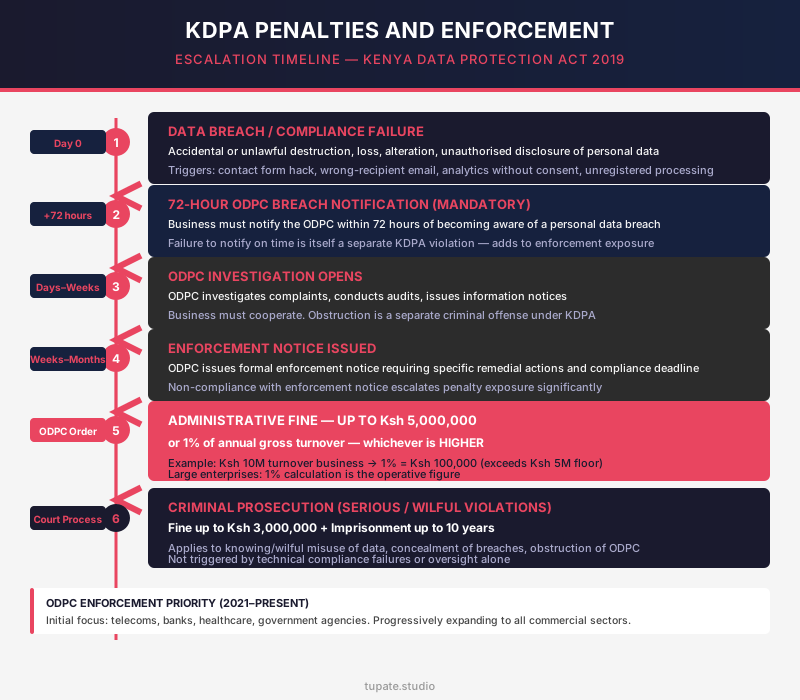
The financial consequences of KDPA non-compliance for Kenyan businesses are substantial. The ODPC has the authority to issue administrative fines of up to Ksh 5,000,000 (approximately USD 35,000 at 2024–2025 exchange rates) or 1% of a company's annual gross turnover, whichever figure is higher.
For a Kenyan SME with Ksh 10 million annual turnover, the 1% threshold produces a Ksh 100,000 fine, which exceeds the administrative maximum. For larger Kenyan businesses, the 1% calculation becomes the operative figure.
Beyond administrative fines, the KDPA creates criminal offenses for knowing and wilful violations. These offenses carry fines of up to Ksh 3,000,000 and, in the most serious cases, imprisonment of up to 10 years.
Criminal exposure is most relevant where a business has deliberately misused personal data, concealed a data breach, or obstructed an ODPC investigation, not merely for oversight or technical compliance failures. However, the existence of criminal provisions signals the Kenyan legislature's intent to treat serious personal data violations with significant severity.
One of the most operationally impactful KDPA requirements is the mandatory data breach notification obligation. Kenyan businesses must notify the ODPC within 72 hours of becoming aware of a personal data breach, defined as any accidental or unlawful destruction, loss, alteration, unauthorised disclosure of, or access to, personal data.
For a Kenyan business website, this includes: a database hack exposing customer contact information, an email sent to the wrong recipient containing personal data, or an insecure website form transmitting data in plaintext. The 72-hour window is tight; it requires that Kenyan businesses have a documented data breach response plan in advance, not only after an incident occurs.
The ODPC's enforcement activity has focused initially on large data processors, Kenyan telecoms companies, banks, healthcare providers, and government agencies, and several Kenyan organisations across these sectors have received investigation notices since 2021. Enforcement is progressively expanding to commercial businesses across all sectors.
Reputational damage from a publicised ODPC investigation or enforcement action adds a commercial cost beyond financial penalties, particularly in Kenya's increasingly privacy-conscious B2B procurement environment where enterprise clients conduct supplier due diligence that includes compliance checks.
KDPA Compliance Checklist
Use this checklist to assess your Kenyan business website's current KDPA compliance status. Each item represents a distinct legal requirement under the Kenya Data Protection Act 2019. For items not yet in place, the guidance below each item describes the corrective action required.
- Privacy Policy page published and linked in footer. The Privacy Policy must be accessible from every page of the website, current, and accurately describe your data processing activities. Tupate Studio provides a KDPA-compliant Privacy Policy template with every website build.
- Cookie consent banner implemented. Required if your website uses Google Analytics, Google Ads conversion tracking, Facebook Pixel, TikTok Pixel, or any other non-essential third-party script that places cookies on visitor devices. The banner must allow active opt-in, not pre-ticked consent.
- Contact forms include Privacy Policy link and consent statement. Every data collection form on the website, contact forms, quote request forms, newsletter sign-ups, booking forms, must state the purpose of data collection and link to the Privacy Policy.
- Google Analytics configured with IP anonymization. In Google Analytics 4, IP anonymisation is applied by default. For legacy Universal Analytics installations (now sunset by Google), IP anonymization required a code-level configuration. Confirm your analytics setup with Tupate Studio if uncertain.
- Data Processing Agreements signed with third-party processors. For Google (Analytics, Ads), email marketing platforms, CRM systems, and cloud hosting providers, confirm DPAs are in place. For Google services, this is typically accepted through the Google Ads and Analytics account settings.
- ODPC registration application filed. If your business processes personal data above ODPC-specified thresholds, registration at odpc.go.ke is required. Annual renewal is mandatory. Consult a qualified Kenyan data protection lawyer to confirm whether your business meets the registration threshold.
- Staff trained on handling customer data rights requests. Under KDPA, Kenyan customers have the right to access their data, correct inaccuracies, and request deletion. Your team must know how to respond to these requests within the 21-day statutory response window.
- Data breach response plan documented. A written procedure for detecting, assessing, and reporting a personal data breach within 72 hours to the ODPC, before an incident occurs, not after.
- Privacy Policy reviewed and updated annually. KDPA compliance is not a one-time setup. As your website adds new features, analytics tools, or data collection mechanisms, the Privacy Policy must be updated to reflect those changes.
All new websites built by Tupate Studio include a KDPA-compliant Privacy Policy template, a functional cookie consent mechanism, and compliant form consent statements as standard deliverables, not optional add-ons. KDPA compliance is a design and technical requirement built into every Kenyan website we produce.
KDPA compliance is a legal floor, not a ceiling. Kenyan customers who encounter a professional Privacy Policy, a functioning cookie consent banner, and a secure HTTPS connection feel more confident submitting their contact details, and that confidence directly increases inquiry form conversion rates.
Tupate Studio builds KDPA compliance into every compliant website Kenya project as a trust-building component, not merely a legal checkbox. Get a free quote to see how a KDPA-compliant website build works in practice.
Frequently Asked Questions
Do I need a Privacy Policy on my Kenyan business website?
Yes, any Kenyan business website that collects personal data (contact forms, email sign-ups, analytics tracking) must have a Privacy Policy page under the Kenya Data Protection Act 2019. This is not optional, it is a legal requirement enforceable by the Office of the Data Protection Commissioner (ODPC Kenya). The Privacy Policy must describe what data is collected, why, how it is stored, whether it is shared with third parties, and how users can exercise their data rights. Tupate Studio includes a KDPA-compliant Privacy Policy template in all website builds as a standard deliverable. This page provides general information, consult a qualified Kenyan data protection lawyer for advice specific to your business.
Does Google Analytics require cookie consent under the Kenya Data Protection Act?
Yes, Google Analytics 4 uses cookies and collects user data including IP addresses (even when anonymised) and detailed browsing behaviour. Under KDPA, Google Analytics is classified as a non-essential cookie because it is not required for the website to function, it serves the business owner's analytics purposes rather than the user's operational need. You must inform Kenyan website visitors about this data collection and obtain their active consent before Google Analytics cookies are placed on their device. A cookie consent banner that defaults to "accept" or uses pre-ticked consent boxes does not meet the KDPA's active opt-in requirement. This is general information, consult a data protection lawyer for advice on your specific analytics configuration.
What should I do if a Kenyan customer asks to see or delete their data from my website?
Under the Kenya Data Protection Act 2019, data subjects, your Kenyan customers, have the right to access the personal data your business holds about them, request corrections to inaccurate data, and request deletion of their data in certain circumstances. You must respond to these requests within 21 days of receiving them. Your website's Privacy Policy should include a dedicated contact email address or data rights request form for these submissions. If you receive a deletion request, you must delete the relevant data from your systems, including any third-party processors such as email marketing platforms or CRM systems, unless you have a legitimate legal basis to retain it. This is general information, consult a qualified Kenyan data protection lawyer for guidance on handling specific requests.
Can I send marketing emails to Kenyan customers without their consent?
No, the Kenya Data Protection Act requires affirmative consent for direct marketing communications to Kenyan individuals. Purchasing a third-party email list and sending unsolicited bulk marketing emails to Kenyans who have not explicitly opted in violates both the KDPA and Kenya Communications Authority regulations. Consent for marketing must be separate from consent to process data for service delivery, a customer who filled in a contact form to request a quote has not thereby consented to receive your monthly newsletter. Consent must be freely given, specific, informed, and unambiguous. The ODPC has indicated that direct marketing abuses are within its enforcement scope. This is general information, consult a qualified data protection lawyer for advice on your marketing consent processes.