Kenya is Africa's most advanced digital economy per capita. With 30 million or more M-Pesa users, 22 million or more internet users, Safaricom's near-total mobile market dominance, and a government committed to ICT-led development, Kenya's digital infrastructure is more sophisticated than most markets its size.
For a Kenyan business, understanding this landscape is not academic, it directly determines which digital tools you adopt, what your customers expect online, and where the growth opportunities are. The businesses that understand Kenya's digital infrastructure build on top of it; the businesses that ignore it build against it.
Kenya has 22–25 million internet users, with over 90% accessing the internet via mobile phone on Safaricom, Airtel, or Telkom networks, making mobile-first digital presence non-negotiable for any Kenyan business.
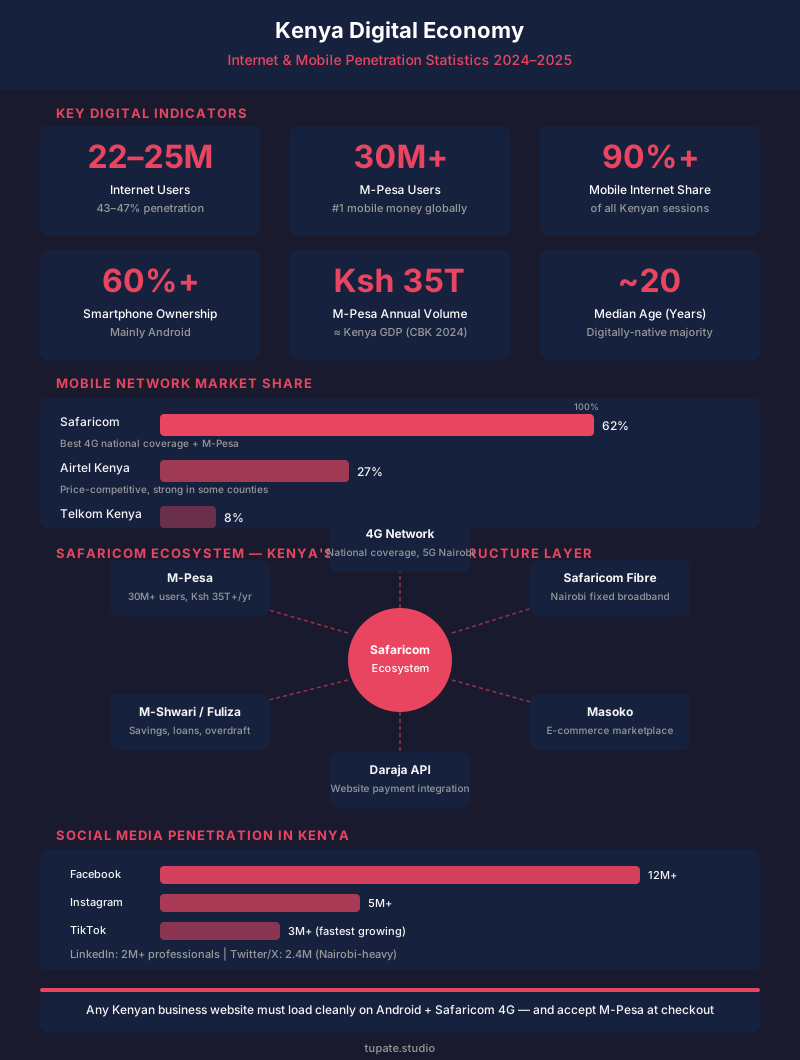
Internet penetration in Kenya stands at approximately 43–47% of the population — 22–25 million people with active internet access as of 2024–2025 estimates. This figure grows annually as Safaricom continues expanding 4G coverage to peri-urban and rural areas, as smartphone prices fall below Ksh 5,000 for entry-level Android devices, and as Kenya's young population (median age approximately 20 years) grows into digital-native adulthood.
The growth trajectory is consistent: Kenya adds several million new internet users annually.
The defining structural characteristic of Kenyan internet access is mobile dominance. More than 90% of Kenyan internet sessions originate from a mobile handset, fixed-line broadband is available mainly in Nairobi CBD commercial buildings and middle-to-upper income residential areas.
For the vast majority of Kenyan internet users, particularly outside Nairobi, mobile data from a Safaricom, Airtel, or Telkom SIM card is their only internet connection. This structural reality has a direct implication for every Kenyan business website: if your website does not load cleanly, quickly, and fully on a mid-range Android phone on Safaricom 4G, it is not functional for the majority of your potential Kenyan customers.
Kenya's mobile network landscape is a three-player market with clear hierarchy. Safaricom holds 60–65% market share, operates the best 4G coverage nationally (including significant rural coverage), and runs M-Pesa, making it the foundational digital infrastructure provider for Kenya. Airtel Kenya holds 25–30% market share and competes aggressively on data pricing, making it the dominant operator in price-sensitive segments and certain counties. Telkom Kenya holds 5–10% market share in a niche segment, primarily in enterprise fixed-line services. 4G coverage is fully deployed across urban Kenya, Nairobi, Mombasa, Kisumu, Nakuru, and Eldoret.
Peri-urban 4G is expanding. Rural Kenya remains largely 2G/3G, with 4G tower deployment ongoing. Average data speeds: Safaricom 4G in Nairobi urban delivers 15–30 Mbps download in typical conditions; rural 3G delivers 2–5 Mbps. Website load time optimisation for Kenyan audiences must account for this speed range, a website that loads in 1.2 seconds on fibre broadband may take 4–6 seconds on rural 3G.
Social media penetration in Kenya reflects the mobile-dominant reality: Facebook has 12 million or more Kenyan users and remains the largest platform by user count; Instagram has 5 million or more users; TikTok has 3 million or more and is growing rapidly among under-30 Kenyans; LinkedIn has 2 million or more professionals; Twitter/X has approximately 2.4 million active Kenyan users, disproportionately represented in Nairobi's professional and political classes. Smartphone ownership exceeds 60% of Kenyans, predominantly Android, Samsung, Tecno, and Infinix dominate.
The smartphone as the primary computing device for most Kenyans means that digital marketing, e-commerce, and customer communication must all be optimised for Android mobile.
Safaricom is not simply a telecommunications company, it is Kenya's digital infrastructure layer, and any Kenyan business that does not integrate with the Safaricom ecosystem is operating outside the primary channel through which Kenyan consumers transact.
Safaricom's market position in Kenya is structurally different from any telecom operator in Europe or North America. In most markets, a mobile network operator carries calls and data, the commerce and payments happen through separate banking infrastructure. In Kenya, Safaricom carries calls, data, and money.
M-Pesa, Safaricom's mobile money service, is the national payment infrastructure for consumer and SME transactions. Ksh 35 trillion or more transacted annually through M-Pesa (2024 Central Bank of Kenya data) represents a sum approaching Kenya's annual GDP flowing through a single mobile payments platform. This is not a payment option for Kenyan businesses, it is the payment infrastructure.
M-Pesa Business, operating under the brand Lipa Na M-Pesa, is used by 600,000 or more Kenyan businesses to receive payments. Integration for website and app-based payments happens via the Daraja API, Safaricom's developer platform. The STK Push payment flow (officially: Customer to Business, C2B) allows a Kenyan customer to pay directly from their Safaricom phone by entering their phone number at checkout, receiving a payment prompt, and confirming with their M-Pesa PIN.
No bank card, no account number, just a phone and a PIN. The M-Pesa payment integration for websites that Tupate Studio builds uses the Daraja API to deliver this exact flow, handling the authentication, sandbox testing, and go-live certification that Safaricom requires.
Safaricom Fibre is expanding residential and commercial fibre broadband coverage in Nairobi, providing a growing segment of Kenyan households and businesses with fixed-line high-speed internet. This is gradually creating a Nairobi professional segment that accesses the internet via laptop and desktop more frequently than the mobile-dominant national average, relevant for B2B-focused Kenyan businesses whose target audience is Nairobi office workers.
Safaricom's financial services ecosystem within M-Pesa, M-Shwari (savings and loans), KCB M-Pesa (bank-backed loans), Fuliza (overdraft), and M-Pesa Global (remittances), is evolving Safaricom toward super-app status, deepening the integration between mobile, payments, and financial services for Kenyan consumers and businesses.
Starlink's arrival in Kenya from 2023 is expanding high-speed internet access to rural areas and small towns where Safaricom 4G coverage is limited or absent. At Ksh 6,000–8,000 per month for hardware and service, Starlink is currently an option primarily for rural businesses, schools, and higher-income households rather than general consumers.
Its medium-term impact will be to raise the floor of internet quality for rural Kenyan internet users, reducing the gap between rural 3G speeds and urban 4G speeds that currently creates different website performance tiers for Kenyan audiences.
Nairobi's Silicon Savannah is the second-largest technology startup ecosystem in sub-Saharan Africa, and the tools, APIs, and infrastructure built there are directly available to Kenyan businesses that know how to use them.
Silicon Savannah is Nairobi's established identity as a technology startup hub. The nickname reflects a genuine concentration of technology companies, venture capital investment, and digital talent in Nairobi, second in sub-Saharan Africa only to Lagos by startup count and VC investment.
This is not aspirational branding, it is a description of a functioning ecosystem with real infrastructure, real capital, and real exits that has been building since the early 2010s, anchored by M-Pesa's demonstration that mobile technology could transform financial services in a developing market.
The physical infrastructure of Silicon Savannah includes Nairobi Garage (co-working spaces across Nairobi), iHub in Kilimani (historically Africa's most influential tech hub, having incubated dozens of Kenyan startups), Strathmore @iLabAfrica (Strathmore University's technology commercialisation unit), C4DLab at the University of Nairobi, and Konza Technopolis, the government-backed city-scale ICT development 60km southeast of Nairobi, intended to become Kenya's dedicated technology city. These spaces produce a pipeline of Kenyan technology talent and companies that continue improving Kenya's digital infrastructure.
The startup verticals strongest in Kenya's tech ecosystem reflect Kenya's specific market opportunities: fintech (M-Pesa derivative services, savings, lending, insurance), agritech (connecting farmers to markets and inputs), healthtech (telemedicine, electronic health records for Kenya's mixed public-private health system), logistics technology (Sendy, logistics automation), and e-commerce enablement (payment, delivery, inventory management for Kenyan online sellers). Kenyan unicorns or near-unicorn valuations: M-Pesa (Safaricom subsidiary, valued above $1 billion), Cellulant (pan-African payments), Flutterwave (Nigeria-Kenya fintech), Chipper Cash (cross-border payments).
For Kenyan businesses that are not startups, the practical implication of Silicon Savannah is access to a rich ecosystem of Kenya-market-specific digital tools. Sendy for logistics API integration. Daraja for M-Pesa. Pesapal for multi-payment-method gateway.
Tanda for agent banking. These are not generic global SaaS tools adapted for Kenya, they are Kenya-native tools built for Kenya's specific payment, logistics, and connectivity infrastructure. A Kenyan business working with a digital partner like Tupate Studio benefits from this ecosystem because all of these tools can be integrated into a custom-coded Kenyan business website.
Kenya's government ICT policy, through the Digital Economy Blueprint, Kenya ICT Authority, and the Kenya Data Protection Act 2019 — creates both opportunities and compliance obligations that every Kenyan business operating online must understand.
Kenya's Digital Economy Blueprint (2019) is the government's strategic framework for positioning Kenya as Africa's digital economy leader. It covers five pillars: digital infrastructure, digital services and government, digital business, digital skills, and innovation.
The practical outcomes for Kenyan businesses include government investment in 4G infrastructure, the eCitizen platform (enabling government services online, business registration, tax filing, vehicle licensing), and the Kenya National Digital Master Plan. These investments directly expand Kenya's internet-using population and the digital tools available to Kenyan businesses.
The Kenya ICT Authority is the regulatory body overseeing ICT standards, government technology systems, and e-government service delivery. For Kenyan businesses, the ICT Authority is most relevant in the context of government procurement, some Kenyan government digital contracts require data hosting within Kenya's borders under a local data hosting mandate.
Businesses serving public sector clients should ensure their websites and applications are hosted on Kenyan-based servers or use cloud infrastructure with a Kenya region (AWS Africa region in Cape Town is the closest major cloud region to Kenya; Microsoft Azure and Google Cloud have announced East Africa expansion).
The Kenya Data Protection Act 2019 (KDPA) is the most directly actionable regulation for Kenyan business websites. The KDPA requires that any organisation, Kenyan or foreign, that collects personal data from Kenyan citizens must register as a data controller or processor with the Office of the Data Protection Commissioner (ODPC), publish a Privacy Policy disclosing what data is collected and why, obtain consent before collecting personal data (including via analytics cookies), and implement data security measures appropriate to the risk.
For a Kenyan business website, this means: a Privacy Policy page, a KDPA-compliant cookie consent banner, and a ODPC registration if the business processes significant volumes of personal data. The Kenya Data Protection Act compliance service that Tupate Studio provides ensures websites we build meet these obligations from day one.
Government digital services now enable Kenyan businesses to operate with significantly reduced in-person bureaucracy: eCitizen handles over 5,000 government services online. KRA iTax enables full tax filing, VAT returns, and PAYE compliance online. NTSA handles vehicle registration and driving licence matters online.
Huduma Centres consolidate multiple services. This digitalisation reduces the administrative cost of business compliance in Kenya, a Nairobi company can now complete all regulatory filings online without visiting government offices, provided the business owner has reliable internet access.
Safaricom's 5G network launched in Nairobi CBD in 2023, with limited coverage expanding gradually. 5G's immediate commercial impact for Kenyan businesses is limited — 5G-capable handsets remain premium devices, and 5G coverage is concentrated in central Nairobi. The medium-term implication is higher bandwidth for Nairobi urban mobile users, enabling richer media experiences on business websites.
However, Core Web Vitals standards, Google's page experience ranking signals, apply equally to 5G and 3G connections. A website must load quickly on 3G for rural Kenya, regardless of 5G capability in Nairobi CBD.
In this digital economy, what does a Kenyan business need to compete effectively online? Kenya's digital infrastructure is in place and growing: 22 million or more internet users, 30 million or more M-Pesa accounts, 4G coverage expanding to every county, a government committed to digital services, and a Silicon Savannah ecosystem providing world-class digital tools. The opportunity for Kenyan businesses is real and growing at 15–20% annually. This growth has extended into every sector, including an industrial sector website Kenya that serves as a procurement tool for machinery and equipment buyers.
What separates businesses that capture this opportunity from those that do not is the quality of their digital presence: a professional website design Kenya that loads in under 2.5 seconds on Safaricom 4G, accepts M-Pesa, ranks on Google.co.ke for relevant Kenyan queries, and complies with KDPA. That is what Tupate Studio builds, custom-coded, not WordPress, built on Kenya's digital infrastructure. Our SEO Services in Kenya ensure that once your website is built, Kenyan customers find it. Get a free quote today.
Common questions about Kenya's digital economy and what it means for business
These FAQs address the specific questions Kenyan business owners and managers ask about internet statistics, mobile money leadership, and data protection compliance.
Frequently Asked Questions
How many Kenyans shop online?
Approximately 8–12 million Kenyans made an online purchase in 2023–2024, a figure growing at 15–20% annually as M-Pesa penetration increases and more Kenyans gain smartphone access. The majority of these purchases were made via mobile phone using M-Pesa as the payment method, frequently through a combination of website product discovery and WhatsApp transaction completion. Nairobi accounts for the largest share of Kenyan online purchases by value, while upcountry Kenya is growing rapidly as 4G coverage and Sendy delivery networks expand beyond major cities.
What is the Kenya Data Protection Act and does it affect my business website?
The Kenya Data Protection Act 2019 (KDPA) requires any business, Kenyan or international, that collects personal data from Kenyan citizens to register as a data processor with the Office of the Data Protection Commissioner (ODPC), publish a Privacy Policy explaining what data is collected and why, and obtain consent before collecting data via contact forms, analytics cookies, or email marketing. This applies to any website with a contact form, Google Analytics, or an email subscription. Tupate Studio builds KDPA-compliant websites as standard, including Privacy Policy pages and cookie consent banners. WhatsApp us if your existing website needs KDPA compliance review.
Is it true that Kenya leads Africa in digital payments?
Yes, Kenya is consistently ranked first in Africa and among the top globally for mobile money penetration. M-Pesa processes more mobile transactions per capita than most developed markets. The World Bank and IMF consistently cite Kenya as the world's leading mobile money economy on a per-capita basis, a position built on M-Pesa's 2007 launch, Safaricom's network investment, and Kenyan consumer adoption driven by a lack of accessible banking infrastructure at launch. For Kenyan businesses, this means your customers are more comfortable with digital payments than the customers of many European or American businesses, mobile payment capability is a basic expectation, not a premium feature.