Kenya has 7+ million MSMEs (Micro, Small, and Medium Enterprises), the backbone of the economy, employing over 80% of the workforce. Yet fewer than 30% have a professional website, and most rely exclusively on WhatsApp, physical walk-ins, and word-of-mouth for customer acquisition.
This gap between Kenya's sophisticated digital infrastructure and SME digital adoption represents both a massive opportunity for those who digitize early, and a growing competitive risk for those who don't.
Kenya has 7.4 million registered SMEs, and fewer than 30% have a professional website, making digital adoption the single largest untapped growth lever in the Kenyan economy.
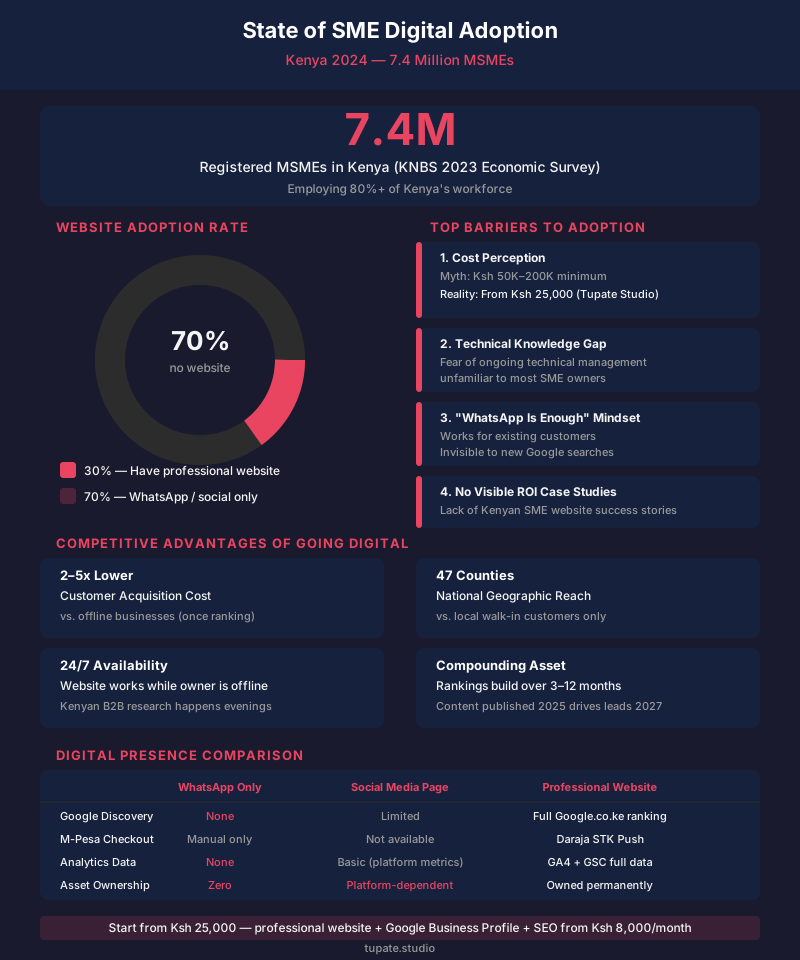
According to the Kenya National Bureau of Statistics (KNBS) 2023 Economic Survey, Kenya has over 7.4 million registered micro, small, and medium enterprises. These businesses span every sector, retail, services, agriculture, logistics, healthcare, and they collectively account for the majority of formal and informal employment in the country.
Despite this scale, digital adoption among Kenyan SMEs remains remarkably low.
Fewer than 30% of Kenyan SMEs maintain a professional business website as of 2024 estimates. The majority of these businesses operate their digital presence entirely through Facebook Pages, Instagram profiles, or WhatsApp, platforms designed for communication and entertainment, not for being discovered by new customers searching Google.
A business that exists only on WhatsApp is invisible to the Kenyan customer typing a service query into Google.co.ke.
WhatsApp-first businesses are not a niche phenomenon in Kenya. Hundreds of thousands of Kenyan SMEs conduct their entire customer journey, inquiry, quotation, ordering, and payment confirmation, over WhatsApp.
This model works well for retaining existing customers, but it fundamentally fails at attracting new ones through organic search discovery. A tailoring business in Westlands, a logistics company in Mombasa, or an accountancy firm in Kisumu cannot be found on Google if it has no website.
The reasons for low website adoption among Kenyan SMEs are well-documented. Cost perception is the first barrier: many Kenyan SME owners assume a professional website costs Ksh 50,000 to Ksh 200,000, a myth that persists despite professional custom-coded options being available from Ksh 25,000. Technical knowledge gaps create fear of ownership, the belief that a website requires ongoing technical management the business owner cannot provide.
The "WhatsApp is enough" mentality is perhaps the most entrenched: it functions for current customers but creates no new discovery channel. Finally, the absence of visible Kenyan SME website success stories means many business owners have never seen a direct case for ROI. Tupate Studio exists to close that gap.
Kenyan SMEs that adopt digital tools grow faster because they lower customer acquisition costs, extend geographic reach to all 47 counties, and build compounding online assets their competitors cannot easily replicate.
Digital adoption is not simply about having an online presence for its own sake. The competitive advantage is concrete and measurable. Kenyan SMEs that combine a professional website with Google Business Profile optimisation and basic SEO acquire new customers at two to five times lower cost than purely offline businesses.
The offline business pays for every customer through referral friction, physical advertising, or direct sales effort. The digital business, once its website is indexed and ranking, receives inquiries continuously, without incremental spend per customer.
Geographic reach transforms fundamentally when a Kenyan SME goes digital. A manufacturing company in Nakuru with no website is a Nakuru business. The same company with a well-optimised website is a Kenya-wide business, discoverable by procurement officers in Nairobi, distributors in Eldoret, and export buyers searching from Mombasa.
Kenya's 47 counties represent a national market, accessible through search, without the cost of physical expansion. This is the value of online business growth Kenya: converting local expertise into national reach.
The 24/7 availability of a website is a compounding operational advantage. Kenya's business culture includes significant after-hours inquiry activity, particularly among urban professionals researching suppliers in the evenings. A website works while the business owner is unavailable, customers find service information, read case studies, calculate pricing, and submit inquiries at 11 PM on a Sunday.
No staff cost. No missed opportunity.
Credibility is a direct commercial factor in Kenyan B2B purchasing. When a Nairobi procurement manager evaluates two potential suppliers, the supplier with a professional website, displaying portfolio, certifications, team, and client logos, wins the first impression before a single call is made.
The supplier without a website is frequently disqualified before engagement begins. Digital tools including GA4 and Google Search Console also give Kenyan SME owners actionable data, which services attract the most searches, which pages convert visitors to inquiries, that offline businesses simply cannot access.
The compounding effect is the most strategically important dynamic. Kenyan SMEs that invest in digital today accumulate search rankings, Google reviews, backlinks, and indexed content that become progressively more difficult for later competitors to match.
The business that starts digital adoption in 2025 will have three years of historical search data, domain authority, and indexed content by 2028. The business that waits until 2028 starts from zero against an entrenched competitor.
Digital adoption for a Kenyan SME follows six sequential steps, beginning with free Google Business Profile registration and progressing to a Ksh 25,000 professional website, M-Pesa integration, and structured SEO.
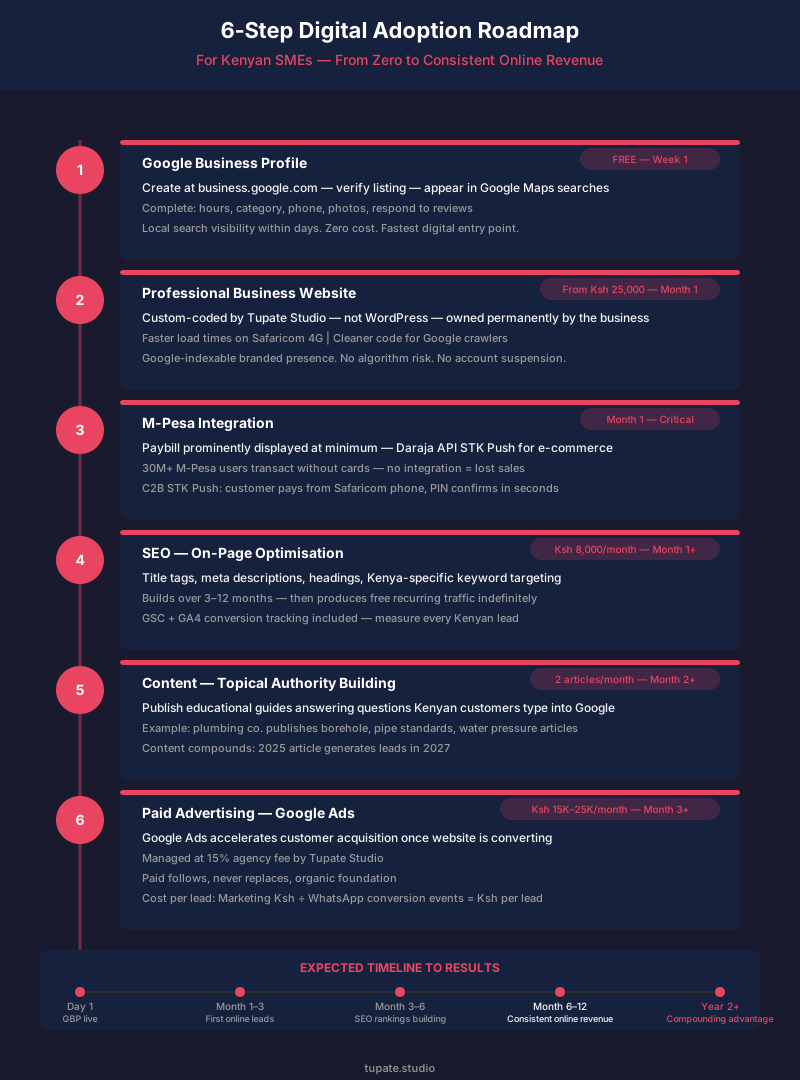
Step 1 is Google Business Profile. It is free, immediate, and requires no website. Any Kenyan business can create a Google Business Profile at business.google.com, verify the listing, and begin appearing in Google Maps results for local searches within days.
A complete profile, with accurate business hours, category, phone number, photos, and responses to customer reviews, places a Kenyan SME directly in front of customers searching for its services nearby. Google Business Profile optimisation Kenya is the fastest zero-cost digital entry point for any Kenyan business.
Step 2 is a professional business website. Tupate Studio builds custom-coded websites from Ksh 25,000 — a permanent, Google-indexable, branded online presence that is owned entirely by the business. Unlike social media pages, a website is not subject to algorithm changes, platform policy decisions, or account suspension.
It is the business's most durable digital asset. Custom-coded (not WordPress or page-builder templates) means faster load times on Kenya's mobile networks and cleaner code for Google's crawlers.
Step 3 is M-Pesa integration. Kenya's payment infrastructure is built around M-Pesa, and a Kenyan business website without M-Pesa payment options creates friction that costs sales.
At minimum, a Paybill number displayed prominently on the website removes the barrier. For e-commerce sites, Daraja API integration enables direct M-Pesa STK Push payments within the checkout flow, converting Kenyan mobile-first shoppers without redirecting them to third-party processors.
Step 4 is SEO. From month one, on-page optimisation, correct title tags, meta descriptions, heading structure, keyword targeting for Kenya-specific search terms, costs Ksh 8,000 per month and begins building organic search visibility.
SEO is not an overnight solution; it builds over three to twelve months. The Kenyan businesses that start early accumulate rankings that produce free, recurring traffic indefinitely.
Step 5 is content. Publishing two educational articles or guides per month, answering the specific questions Kenyan customers type into Google, builds topical authority on the website's subject matter.
A plumbing company in Nairobi that publishes articles about pipe materials used in Kenyan construction, water pressure standards, and borehole compliance becomes the authoritative source Google sends searchers to. Content compounds over time; a piece published in 2025 can generate leads in 2027.
Step 6 is paid advertising. Google Ads, at a budget of Ksh 15,000 to Ksh 25,000 per month managed at 15% agency fee by Tupate Studio, accelerates customer acquisition once the website is converting organic visitors into inquiries.
Paid advertising should follow, not replace, organic foundation-building. The typical timeline for a Kenyan SME following this sequence: first online leads within one to three months; consistent online revenue contribution by month six to twelve.
Kenyan government agencies, international development organisations, and Safaricom provide support programmes specifically designed to accelerate SME digital adoption in Kenya.
The Kenya ICT Authority operates the Digital Skills Programme, offering free digital literacy training to Kenyan SMEs across the country. These programmes cover foundational digital tools, online business registration, and e-commerce basics, relevant entry points for Kenyan SME owners with limited prior digital exposure.
The Micro and Small Enterprises Authority (MSEA) provides broader SME development support including access to some digital training resources and business development services.
The Ajira Digital Programme, run by the State Department for ICT, targets Kenyan youth with digital work skills, relevant for SMEs looking to hire affordable digital support locally. Konza Technopolis, Kenya's government-developed technology hub south of Nairobi, is designed to host and incubate tech-oriented Kenyan SMEs, with infrastructure and ecosystem support unavailable elsewhere in East Africa.
On the international development finance side, USAID Kenya funds various digital transformation programmes for Kenyan small businesses, often in partnership with Kenyan industry associations. The IFC (World Bank Group) has run digital finance programmes supporting the M-Pesa ecosystem and broader financial digitisation of Kenyan SMEs.
VC4A (Venture Capital for Africa) provides mentorship and investment access for Kenyan startups and growing SMEs ready to scale.
Safaricom Masoko is a government-backed e-commerce marketplace open to Kenyan SMEs, offering immediate visibility to existing Safaricom customer traffic without the cost of building an independent e-commerce site. Airtel Business Kenya provides SME digital solutions packages for connectivity and communication.
The Kenya Revenue Authority's iTax platform simplifies digital tax filing for Kenyan businesses, with companies under Ksh 5 million annual turnover qualifying for the simplified turnover tax regime, reducing the compliance burden that discourages formal digital business operations.
For most Kenyan SMEs, the highest-impact digital investment combines a professional business website with Google Business Profile optimisation. These two assets create the digital foundation, the website is the conversion engine, the Google Business Profile is the local discovery tool. Built correctly and optimised for Google.co.ke, they generate Kenyan customer inquiries continuously without ongoing advertising spend. If you already have a site that is underperforming, it may be time to revamp your business website Kenya.
For the foundational search visibility that every Kenyan SME needs, small business digital Kenya search optimisation is where to start. Understanding how SMEs going online Kenya scale from first website to national reach gives you the roadmap, and the digital economy Kenya overview provides the infrastructure context every Kenyan business owner should understand. Tupate Studio builds the complete digital foundation, starting with website design from Ksh 25,000. WhatsApp us or get a free quote to begin your digital adoption journey today.
Frequently Asked Questions: SME Digital Adoption in Kenya
Can a Kenyan SME with a Ksh 25,000 budget build a meaningful online presence?
Yes, a Ksh 25,000 professional website from Tupate Studio combined with a free Google Business Profile setup creates a functional digital presence that generates organic leads. The website provides a permanent, Google-indexable home for the business; the Google Business Profile ensures visibility in local and Maps searches immediately. Combined with a Ksh 8,000/month SEO retainer from month three, this is a complete and affordable digital growth system for a Kenyan SME. The total investment in year one, Ksh 25,000 website plus six months of SEO, is Ksh 73,000, which is less than the cost of a single month of traditional billboard advertising in Nairobi.
How do I know if my Kenyan business is ready for a website?
If you have a product or service that Kenyan customers search for online, you are ready for a website. Use Google Keyword Planner (free with a Google Ads account) to check monthly search volumes for your service keywords in Kenya, if there are hundreds or thousands of monthly searches, there is organic traffic available for your business to capture. Even businesses with zero current digital presence typically see ROI from a professional website within three to six months if their service category has demonstrated search demand. If you are unsure, WhatsApp us at Tupate Studio and we will run a free keyword demand check for your business category.
Should a Kenyan SME use a marketplace (Jumia, Masoko) or its own website?
Both, and they serve different strategic functions. Marketplaces like Jumia Kenya and Safaricom Masoko provide immediate access to an existing audience of Kenyan online shoppers, which is valuable when a business has no established digital presence or search rankings. However, marketplace sales carry commission fees (typically 5–20% per transaction on Jumia), offer no brand differentiation from competitors listed beside you, and build no long-term search asset. An owned business website carries zero per-transaction fees, builds Google rankings and brand equity over time, and gives full control over the customer experience and data. Many successful Kenyan e-commerce SMEs use both in parallel: marketplace for volume today, own website for brand and margin growth over time.