Kenya's e-commerce market was valued at approximately $3.5 billion in 2023 and is growing at 15–20% annually, driven by mobile internet penetration, M-Pesa's dominance as a payment method, and a young, digitally-native population. For Kenyan businesses still operating offline or with underperforming online stores, this growth represents a significant opportunity that competitors are increasingly capturing.
Understanding how this market works, who is buying, how they pay, how goods are delivered, and where the gaps remain, is the first step to building an e-commerce presence that converts.
Kenya's e-commerce market is valued between $3.5 and $4.5 billion USD and ranks in the top three in sub-Saharan Africa, driven by M-Pesa adoption, smartphone penetration exceeding 60%, and a growing urban middle class.
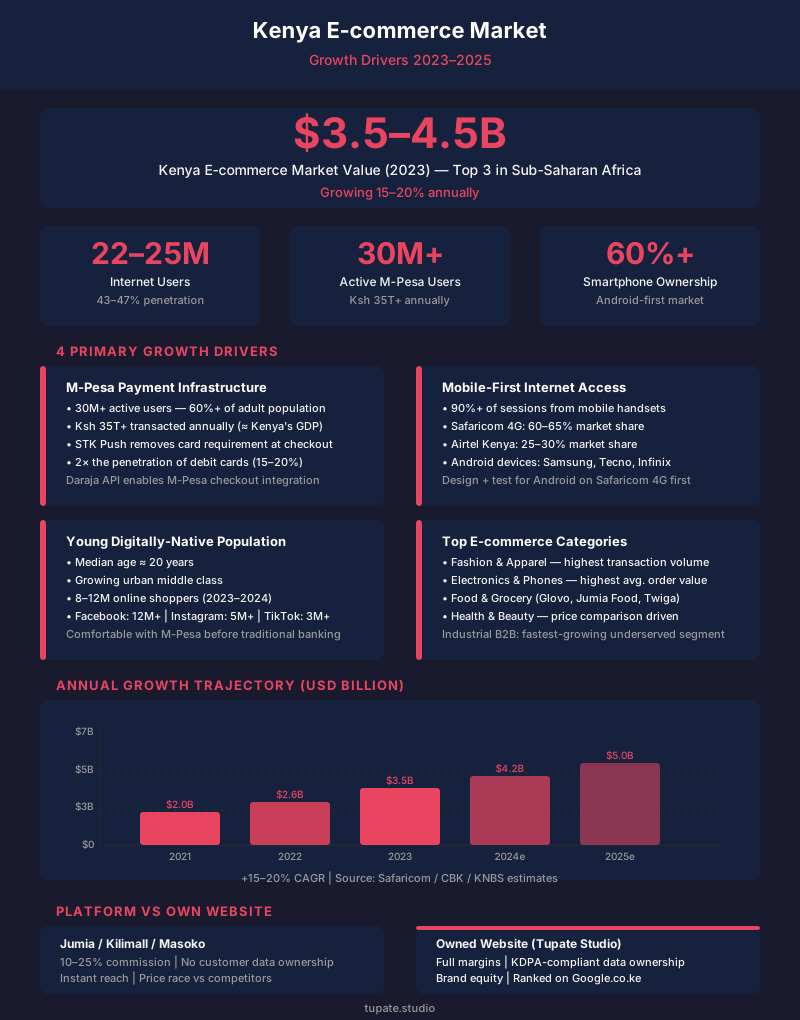
Internet penetration in Kenya stands at approximately 43–47% of the population — 22–25 million people with internet access in 2024–2025. This figure grows every year as Safaricom expands 4G coverage and smartphone prices continue declining.
Critically, the majority of Kenyan internet access is mobile, Safaricom, Airtel, and Telkom deliver connectivity primarily via handsets, not fixed broadband. This mobile-first reality directly determines how Kenyan e-commerce operates: purchases are made on phones, payments are sent via M-Pesa, and delivery instructions are communicated via WhatsApp.
Smartphone ownership exceeds 60% of Kenyans as of 2024–2025 — predominantly Android devices from Samsung, Tecno, and Infinix. These are the primary e-commerce devices in Kenya.
Desktop e-commerce is secondary, accounting for a minority of transactions. Any Kenyan business building an online store must design and test primarily for Android mobile on Safaricom 4G, not for desktop Chrome on fibre broadband.
M-Pesa is the foundational enabler of Kenya's e-commerce market. With 30 million or more active M-Pesa users transacting over Ksh 35 trillion annually (per Central Bank of Kenya 2023–2024 data), M-Pesa removes the payment friction that suppresses e-commerce in markets that depend on credit and debit card penetration.
Only 15–20% of adult Kenyans have debit cards, M-Pesa's penetration is double this. A Kenyan e-commerce store that accepts only card payments is structurally inaccessible to the majority of its potential customers.
The major product categories dominating Kenya e-commerce by transaction volume: fashion and apparel holds the highest volume position, driven by Jumia Kenya, Kilimall, and thousands of Instagram boutiques converting via WhatsApp. Electronics and phones represent the highest average transaction value segment. Food and grocery e-commerce is growing rapidly, Glovo, Jumia Food, and Twiga Foods have built significant infrastructure.
Health and beauty products perform strongly online because Kenyan consumers comparison-shop cosmetics by price across platforms. Industrial spare parts represent a growing B2B e-commerce segment, previously dominated by physical markets in Industrial Area Nairobi, that is now partially moving online as procurement managers research and quote via websites.
The major Kenya e-commerce platforms, Jumia Kenya, Kilimall, Masoko (Safaricom's marketplace), and Pigiame (classifieds), coexist with thousands of individual business online stores. The platform vs own-store strategic decision is significant for Kenyan businesses: a Jumia listing gives immediate marketplace reach but charges 10–25% commission, creates price competition, and prevents direct customer relationships.
An owned e-commerce website costs more to build initially but delivers full margins, KDPA-compliant customer data ownership, and a branded purchase experience.
M-Pesa enables Kenya's e-commerce market by solving the payment problem that limited online commerce before its adoption, and any Kenyan e-commerce store without M-Pesa integration is leaving a majority of potential customers unable to pay.
Before M-Pesa achieved its current penetration, Kenyan e-commerce was constrained by payment infrastructure. Credit card ownership was, and remains, low: 15–20% of adult Kenyans hold a debit card, and credit card ownership is substantially lower. Building an e-commerce store that required card payment excluded 80% of potential Kenyan buyers before they reached the checkout.
M-Pesa's Lipa Na M-Pesa service, specifically the STK Push (Sim Toolkit Push) mechanism, solved this: a customer initiates payment on your website, they receive a prompt on their Safaricom phone, they enter their M-Pesa PIN, and the payment is confirmed in seconds. No card required. No bank account necessary.
M-Pesa business payments are processed via the Daraja API, Safaricom's developer interface, which connects your e-commerce website directly to M-Pesa's payment infrastructure. The STK Push (Customer to Business, C2B) flow initiates payment from the customer's phone after they enter their number at checkout.
The B2C flow enables refunds. This M-Pesa payment integration for websites is a standard requirement for all Kenyan e-commerce websites that Tupate Studio builds.
M-Pesa penetration numbers provide the commercial context: 30 million or more active users, representing over 60% of Kenya's adult population. Ksh 35 trillion transacted annually, approximately equivalent to Kenya's entire GDP flowing through M-Pesa in a year.
Consumer trust in M-Pesa transactions is demonstrably higher than consumer trust in website card payments: Kenyan shoppers who would hesitate to enter a card number on an unfamiliar website will initiate an M-Pesa STK Push without hesitation because the security and dispute resolution model of M-Pesa is established and trusted.
Competing payment methods, Airtel Money, Telkom T-Kash, and bank mobile apps, hold smaller market shares but are worth integrating for maximum Kenyan market coverage. Airtel Money covers 25–30% of Kenya's mobile subscribers; some Kenyan buyers, particularly in lower-income segments and certain counties, use Airtel rather than Safaricom.
Safaricom Fuliza, the M-Pesa overdraft service, is an emerging segment: Kenyan customers who have exhausted their M-Pesa float can complete purchases on credit, expanding the accessible customer base for Kenyan e-commerce businesses, particularly for purchases in the Ksh 2,000–10,000 range.
Kenyan online shoppers make purchasing decisions based on five factors, price visibility, delivery cost, M-Pesa payment availability, social proof, and physical address visibility, and missing any one of these factors reduces conversion significantly.
Mobile phone is the primary device for 80% or more of Kenyan online shopping. A Kenyan consumer researching a product typically follows this sequence: Google search for the product plus "Kenya" or "Nairobi" â product page on a website or marketplace â WhatsApp message to the seller â M-Pesa payment â delivery confirmation via WhatsApp.
This path integrates the website as a discovery and information tool while WhatsApp and M-Pesa handle the transaction, which is why many Kenyan e-commerce businesses operate with a product catalogue website plus a WhatsApp business number rather than a fully automated checkout.
Discovery channels for Kenyan online shoppers: Google search (typing the product name plus "Kenya," "Nairobi," or "price") is the dominant discovery mechanism for high-value and considered purchases. WhatsApp groups and broadcast lists are significant for repeat or referred purchases, a Kenyan who bought a product and shares the WhatsApp number to their group can generate substantial referral volume.
Instagram and Facebook Kenya drive product discovery for visual categories (fashion, home decor, gifts). Jumia and Kilimall are browsed by Kenyans looking for marketplace-style price comparison.
Price transparency is non-negotiable for Kenyan online conversion. Kenyan shoppers actively compare prices between multiple websites, Jumia, and WhatsApp sellers before purchasing. A website that hides prices behind "contact us for a quote" for standard products loses Kenyan visitors who are not yet ready to engage, they will go to a competitor that displays pricing clearly.
Delivery cost is the second most important conversion factor: free delivery or affordable delivery (under Ksh 300 for Nairobi orders) significantly increases purchase completion rates. Many Kenyan e-commerce businesses price delivery separately and lose customers at the final checkout step when delivery adds Ksh 400–600 to a Ksh 800 product.
Social proof, Google reviews, customer photos on WhatsApp, and Instagram testimonials, is disproportionately important for Kenyan e-commerce because fraud remains a genuine concern among Kenyan online shoppers. A new Kenyan e-commerce site with no reviews asking a customer to M-Pesa Ksh 8,000 before delivery faces high abandonment.
A physical address visible on the website, preferably one the customer could verify on Google Maps, substantially reduces this abandonment, it signals that the business is locatable and accountable. Return policy clarity is the final factor: a simple, plainly stated return policy increases Kenyan purchase confidence, particularly for higher-value items.
WhatsApp-based commerce accounts for a significant volume of Kenyan e-commerce that never appears in formal market statistics. A customer sees a product on Instagram, sends a WhatsApp message, receives an M-Pesa number, pays, and receives the product.
This informal channel coexists with website-based commerce, many Kenyan businesses use their website for credibility and discovery while WhatsApp handles the actual transaction. Building a formal e-commerce website that integrates M-Pesa capture differentiates from this majority and enables scale that WhatsApp-only commerce cannot achieve.
Last-mile delivery in Kenya requires solutions for Nairobi's addressing challenges and upcountry logistics, and building the right delivery partner network determines whether a Kenyan e-commerce business can scale nationally.
Nairobi's addressing system presents a specific logistics challenge: many Nairobi properties do not have formal street addresses. Delivery in Nairobi relies on landmarks ("next to Nakumatt Mega," "opposite Total petrol station"), WhatsApp-shared location pins, or Google Plus Codes.
Kenyan e-commerce businesses that ask for "delivery address" in a text field at checkout receive unusable responses from a significant proportion of Nairobi customers, a Google Maps integration that allows customers to pin their location, or a "share your WhatsApp location" instruction, dramatically reduces failed deliveries.
For Nairobi, Mombasa, and Kisumu city deliveries, Boda Boda express delivery via motorcycle couriers is the fastest and most cost-effective last-mile option. Same-day delivery within city limits typically costs Ksh 200–400 and is completed within 2–4 hours.
Sendy connects Kenyan e-commerce businesses to a network of verified motorcycle and van couriers via API, enabling automated delivery booking from your website or order management system. For Kenyan businesses delivering time-sensitive products (food, medicine, flowers, small electronics), Boda Boda is the correct channel.
Upcountry Kenya delivery options present a cost-versus-speed trade-off. Posta Kenya is the most affordable option (Ksh 100–300 per parcel) but delivery takes 2–5 business days and tracking is limited. G4S Kenya provides secure delivery for high-value items and has a national network.
DHL Kenya is available for premium or international shipments. Sendy's API enables programmable logistics booking, Kenyan e-commerce businesses can integrate Sendy directly into their checkout to provide delivery cost quotes and booking at the point of purchase. Delivery time expectations for Kenyan customers: Nairobi CBD to Nairobi suburbs is same-day or next-day; Nairobi to any upcountry location is 2–5 business days via established courier.
Returns management for Kenyan e-commerce SMEs is almost universally handled manually via WhatsApp, the customer messages to initiate a return, the business coordinates collection, and the M-Pesa refund is sent after goods are received. This process works at low volume but fails at scale. Your Kenyan e-commerce website must state the return policy clearly and specifically: "Returns accepted within 7 days for unused items.
Contact us on WhatsApp to initiate. Refunds processed within 48 hours via M-Pesa." Ambiguous or absent return policies are cited consistently in Kenyan consumer surveys as a primary reason for abandoned purchases on unfamiliar e-commerce websites.
Kenya e-commerce has four underserved opportunity segments, industrial B2B, agricultural inputs, professional services, and cross-border East Africa, where a Kenyan business can build significant online market share with relatively low competition.
Property is another major segment with significant online growth potential, a real estate website Kenya with property search, filtering by location and price, and WhatsApp inquiry integration captures buyers who research extensively online before making contact. Industrial spare parts and B2B supplies remain largely offline in Kenya. Procurement managers at Kenyan factories, construction companies, and healthcare facilities still purchase by visiting Industrial Area suppliers in person or by phone.
The business that builds a clean, searchable online catalogue with visible pricing and M-Pesa payment for industrial supplies, valves, bearings, electrical components, safety equipment, captures a Kenyan B2B segment that competitors have not yet digitalised. Unlike consumer e-commerce, B2B buyers in Kenya make repeat purchases at high value, a single corporate account relationship is worth millions of shillings annually.
Agricultural inputs, seeds, fertiliser, pesticides, irrigation equipment, represent a large Kenyan market where the supply chain is fragmented and Kenyan farmers in county towns are underserved by local agrodealer networks. A Kenyan agribusiness with a website that ranks for "certified maize seeds Kenya delivery" or "urea fertiliser price Kenya" can reach farmers across 47 counties who cannot access the product locally and are willing to pay for delivery.
Twiga Foods has demonstrated the model at scale for fresh produce; the inputs segment remains less digitised.
The scale advantage of a Kenyan e-commerce website versus a physical shop is measurable: a physical Nairobi shop in Westlands is accessible to customers within reasonable commuting distance, perhaps 200,000 potential customers. A Kenyan e-commerce website is accessible to all 50+ million Kenyans with internet access across all 47 counties, plus the East African Community market of Uganda, Tanzania, Rwanda, Burundi, DRC, and South Sudan.
The EAC free trade area allows Kenyan e-commerce businesses to sell legally to this region, a market of approximately 300 million people with growing middle-class consumption.
Kenya's informal-to-formal economy transition is an opportunity: millions of Kenyan businesses operate solely via WhatsApp and M-Pesa without a website or formal online presence. Building a proper e-commerce website immediately differentiates a Kenyan business from this majority.
A Kenyan customer searching Google for a product finds the website, not the WhatsApp number. The business with a website captures search-driven demand that WhatsApp-only competitors are invisible to.
How does a Kenyan business build an e-commerce website that captures its share of this growing market? The market opportunity is established, $3.5–4.5 billion and growing at 15–20% annually, with 22 million internet users and 30 million M-Pesa accounts. What separates Kenyan businesses that capture this opportunity from those that observe it is a properly built e-commerce website: M-Pesa STK Push integrated at checkout, mobile-first on Safaricom 4G, product pages that rank on Google.co.ke, and a delivery network configured for both Nairobi and upcountry.
Tupate Studio builds this. Our e-commerce website development Kenya service and custom e-commerce development Kenya are designed specifically for the Kenya market, M-Pesa integrated, KDPA compliant, and optimised for Kenyan mobile users. WhatsApp us to get a free quote for your online store.
Legal, financial, and practical questions about selling online in Kenya
These FAQs address the regulatory, tax, and practical questions Kenyan business owners ask before launching an e-commerce store.
Frequently Asked Questions
Is Kenya e-commerce profitable for small businesses?
Yes, particularly for Kenyan businesses with niche products that are hard to find locally but easily sold nationally via a website. Specialty crafts, artisanal food, industrial supplies for specific machinery, imported goods, and professional services all have strong e-commerce viability in Kenya. The key requirements are a reliable M-Pesa payment integration, a trusted delivery partner (Sendy for Nairobi, Posta Kenya or G4S for upcountry), and product pages that rank on Google.co.ke for relevant Kenyan search queries. Small Kenyan businesses that build this infrastructure consistently report that e-commerce sales exceed walk-in or phone-based sales within 12–18 months.
Do I need a business permit to sell online in Kenya?
Yes, all e-commerce businesses operating in Kenya must have a valid business registration from the Business Registration Service of Kenya (previously the Registrar of Companies), a KRA PIN for tax purposes, and comply with the Consumer Protection Act which governs returns, refunds, and product descriptions for Kenyan online sellers. County business permits (single business permit) are required for businesses with a physical premises. Digital-only businesses still require national business registration and a KRA PIN, selling via M-Pesa without registration does not exempt a business from Kenya tax obligations.
How do I handle VAT on Kenya e-commerce sales?
Kenyan businesses with annual turnover above Ksh 5 million must register for VAT with KRA and charge 16% VAT on applicable products and services. Your e-commerce website should be configured to calculate and display VAT automatically at checkout, customers must see the VAT-inclusive price before completing the M-Pesa payment. Your KRA iTax account must reflect VAT collected monthly via the VAT return. Tupate Studio builds e-commerce websites with VAT calculation built into the checkout process, ensuring your online store is KRA-compliant from launch. WhatsApp us for a free consultation on e-commerce VAT configuration.