On-page SEO is the process of optimizing every element within a web page, its title tag, heading structure, content depth, images, and internal links, so that Google.co.ke correctly understands what the page is about and ranks it for Kenyan search queries. For your Kenyan business website, on-page SEO is what transforms an invisible page into one that consistently appears when potential customers in Nairobi, Mombasa, or Kisumu search for your services.
As part of our broader SEO Services in Kenya, Tupate Studio optimizes every page individually so each one earns its own rankings for targeted Kenyan queries.
What On-Page SEO Covers for a Kenyan Business Website

On-page SEO covers every element that exists within the web page itself, the content a visitor reads, the code a browser renders, and the signals Google's crawlers evaluate when deciding what the page is about and how to rank it. For a Kenyan business website, the on-page elements that matter are: the title tag (shown in Google search results), the meta description (the snippet below the title), the H1 through H6 heading hierarchy, the body content and its depth, all images including their alt text and file format, internal links connecting this page to other pages on your site, the URL structure, and schema markup that adds structured meaning for Google.
On-page SEO is explicitly not server speed, not crawlability, not hosting location, and not backlinks from other websites. Server-side factors belong to a technical SEO audit. Off-page authority comes from external links and local citations. These are separate disciplines that work alongside on-page optimization, not substitutes for it.
In Kenya's search market, the distinction matters practically. Google.co.ke uses the same core ranking signals as global Google, but Kenyan search volumes mean that even 50–200 monthly searches for a Nairobi-specific query represents significant business.
A dental clinic ranking first for "dental implants Westlands" may receive only 80 clicks per month, but those 80 Kenyan searchers are high-intent buyers. Getting those clicks depends entirely on each page being individually optimized to match that exact query context.
The compounding effect is decisive: a 10-page Kenyan business website where every page has a specific keyword focus, correct heading structure, and adequate content depth will consistently outperform a 50-page site built without on-page discipline. More pages are not better, more correctly optimized pages are better. On-page SEO also prevents keyword cannibalization, where multiple pages on your Kenyan site compete for the same query and cancel each other's rankings out.
Each properly optimized page targets one specific query cluster, sending a clean, unambiguous signal to Google about its topic. Tupate Studio applies this discipline to every page we build for Kenyan businesses as standard practice.
Title Tags and Meta Descriptions That Get Clicks in Kenyan Search Results
Your title tag is the single most important on-page SEO element, it tells Google what query your page should rank for and it is the first text Kenyan searchers see in the results. A properly structured title tag for a Kenyan business website follows a clear formula: primary keyword first, brand name last, kept between 50–60 characters so Google displays it in full at its 600px result width.
For example: "Website Design Kenya | Tupate Studio" places the commercial keyword first where it carries the most ranking weight, then appends the brand for recognition.
Kenya-specific CTR modifiers significantly increase click rates in Google.co.ke results. Including a city name (Nairobi, Mombasa, Kisumu), a year ("2025"), a pricing signal ("Ksh pricing available"), or a conversion driver ("Free Quote") in your title tag lifts click-through rates by 15–25% compared to generic title tags in Kenyan SERPs.
Kenyan SME searchers respond to price transparency, a title tag that includes "from Ksh 25,000" draws more clicks than one that does not.
Title tag mistakes on Kenyan business websites include: duplicate titles across multiple pages (Google cannot distinguish the pages' topics), keyword stuffing ("Best SEO Kenya SEO Nairobi SEO Company"), and click-bait titles mismatched to the page content (high bounce rate signals damage rankings over time). Every page on your Kenyan website requires a unique title tag matched to its specific topic.
Meta descriptions do not directly affect Google rankings, Google has confirmed this. However, a well-written meta description lifts CTR by signalling to the Kenyan searcher that your page answers their specific query.
Your meta description should be 145–160 characters, include the primary keyword, reference the Kenyan context ("for Nairobi businesses," "serving Kenya"), and end with a call to action: "WhatsApp us," "Get a free quote," "Call us today." Including a Ksh price signal in the meta description is a high-impact CTR tactic specific to Kenya's SME search market, where price is a primary decision factor before clicking. Tupate Studio writes unique, conversion-optimized title tags and meta descriptions for every page of your Kenyan business website.
Heading Structure: How H1, H2, H3 Tags Affect Your Kenya Rankings
Heading tags are semantic signals, not formatting tools, Google reads your H1, H2, and H3 tags to understand what topics your page covers and how important each topic is relative to the others. For a Kenyan business website, using headings incorrectly means Google assigns ranking weight to the wrong topics, or assigns no clear weight at all.
Every page must have exactly one H1 tag. The H1 contains your primary keyword and matches the search intent of the target Kenyan query precisely. There is no flexibility here, multiple H1 tags on a single page (a common default in many WordPress themes) split Google's topic signal and weaken rankings.
Your H1 is not a welcome message. It is a ranking declaration: "this page is about this specific topic for Kenyan searchers."
H2 tags define the sub-topics that answer the representative queries Google associates with your main topic. They are not section labels ("Our Services," "About Us"), they are query-answering statements that process distinct aspects of the page's topic.
The order of your H2 tags creates a contextual hierarchy: the first H2 after the H1 receives the greatest contextual weight from Google. If your dental clinic page lists "Why Choose Us" as the first H2 instead of "Dental Services in Nairobi: General Dentistry, Orthodontics, and Cosmetic Procedures," you have given Google no keyword signal in the highest-weight position on the page.
The practical difference is significant. A Nairobi dental clinic page with H2 "Our Services" processes one vague term for Google.
A page with H2 "Dental Services in Nairobi: General Dentistry, Orthodontics, and Cosmetic Procedures" processes three specific Nairobi-relevant service terms that match distinct Kenyan search queries. The second version ranks for 3x more Kenyan search queries from a single heading change.
H3 tags provide attribute-level depth beneath each H2 context, they answer the specific sub-questions Kenyan searchers ask within that topic. Common heading mistakes on Kenyan business websites include: using H3 before establishing an H2 (breaks the semantic hierarchy), using decorative headings ("Welcome to Our Company"), and repeating the same heading format across every section without differentiating query targets.
Tupate Studio audits and restructures heading hierarchies as a core component of on-page SEO for every Kenyan business website we work on.
Content Depth for Kenyan Business Keywords: How Much Is Enough
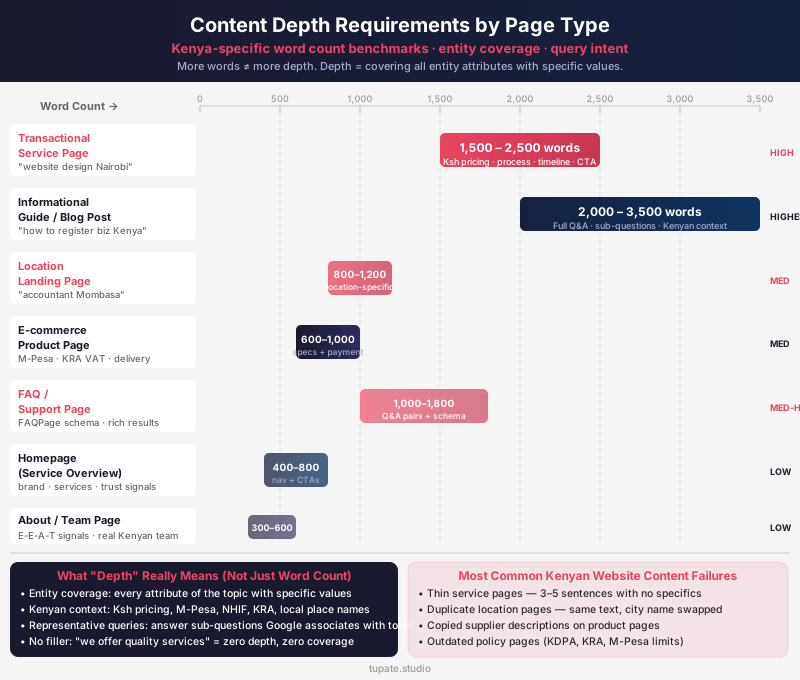
Content depth means covering all relevant attributes of your topic with specific values, not writing more words. A 3,000-word page that says "we offer quality dental services" three hundred times has zero content depth.
A 900-word page that specifies NHIF coverage, operating hours, available procedures, dentist qualifications, and appointment booking methods has high content depth. Google's ability to understand a Kenyan business page is determined by the completeness of information about the topic's entity, attributes, and values, not by word count alone.
That said, word count benchmarks reflect the depth required to satisfy different query types in Kenya. Transactional service pages targeting queries like "website design Nairobi" require 1,500–2,500 words to cover all the attributes a Kenyan buyer needs to make a decision: pricing (in Ksh), process, timeline, technology, examples, and a clear call to action.
Informational guides targeting queries like "how to register a business online Kenya" require 2,000–3,500 words to fully answer the question and all related sub-questions. Local landing pages targeting single-location queries ("accountant Mombasa") require 800–1,200 words of location-specific, service-specific content.
Entity coverage defines what must be present for Google to fully understand your page's topic. A page targeting "dental clinic website design Kenya" must mention appointment booking systems, NHIF payment integration, doctor profile pages, patient registration forms, Google Maps embedding, not just "we design clinic websites." Each of those attributes is a search signal that connects your page to the full range of related Kenyan queries.
Before writing any page, Tupate Studio conducts SEO keyword research Kenya to identify the complete attribute set a Kenyan business page must cover to match the query context.
The most common content depth failures on Kenyan business websites are thin service pages (3–5 sentences describing the service with no specifics), duplicate content across location pages (same text with city name swapped), and copied manufacturer or supplier descriptions on product pages that appear on hundreds of other Kenyan e-commerce sites. All three signal low quality to Google.
Content freshness applies to Kenya-specific information: pages touching government policy (KDPA compliance, KRA filing requirements), M-Pesa transaction limit changes, or Kenya ICT Authority licensing requirements should be reviewed and updated annually to maintain ranking relevance.
Image Optimization for Kenyan Websites: Alt Text and WebP Format
Image optimization serves two goals simultaneously: it tells Google what your images depict (alt text = SEO signal) and it reduces the data Kenyan mobile users consume loading your page (format and size = user experience signal). For a Kenyan business website serving customers predominantly on Safaricom or Airtel Kenya mobile data, both goals are equally important.
Alt text must be descriptive and keyword-informed. "custom website design for Nairobi law firm" communicates both the image content and the page's topic context to Google. "image1.jpg" or an empty alt attribute does neither. Write alt text for every image on your Kenyan business website as if you were describing it to someone who cannot see it, Google's image processing systems use this description as a relevance signal connecting the image to the page's keyword context.
WebP is the mandatory image format for Kenyan websites. WebP images are 25–35% smaller than JPEG at the same visual quality, directly reducing the data cost for Kenyan mobile users who pay per MB on Safaricom, Airtel Kenya, or Telkom Kenya data bundles.
File size targets are strict: hero images (the large banner at the top) must stay under 120KB in WebP format; body images must stay under 60KB; thumbnail images under 20KB. An uncompressed JPEG hero image at 800KB costs a Kenyan 4G user visible load delay and potential bounce before the page has finished loading.
Descriptive file names contribute to image SEO: save your files as "/nairobi-website-designer.webp" rather than "/DSC00234.jpg", Google reads file names as a relevance signal. Lazy loading (the HTML attribute loading="lazy") defers off-screen images from loading until the Kenyan user scrolls to them, reducing the initial page weight. The srcset HTML attribute serves appropriately sized images to different screen widths, a Tecno Spark 10 running at 720px width does not need a 1,200px-wide image that costs extra mobile data to download.
Finally, Kenya-specific photography, real staff, real offices, real Kenyan settings, builds trust signals that generic stock photography cannot replicate on a Kenyan business website. Tupate Studio handles image optimization at every stage of website development as part of our on-page SEO process.
Internal Linking Strategy: How Pages on Your Kenyan Site Support Each Other
Internal links are contextual bridges, they tell Google which pages on your Kenyan website are related to each other, distribute PageRank (ranking authority) between pages, and create the topical connections that define your site's expertise in a given area. A Kenyan business website with no internal linking strategy has pages that rank in isolation, or don't rank at all because Google's crawler cannot find them.
Three types of internal links serve different purposes. Navigational links (in your header menu and footer) establish the permanent hierarchy of your site, homepage links to service pages, service pages link to contact.
Contextual links (within the body content of a page) are the highest-value internal links for SEO, they pass PageRank directly from the linking page to the target page and create a relevance connection between the two topics. Supplementary links (in a sidebar or related posts section) provide additional discovery paths without the same ranking weight as contextual links.
Anchor text is critical: every internal link must use descriptive, keyword-rich text that matches the target page's topic. Never use "click here," "read more," or "learn more" as anchor text, these pass no topical signal to Google.
When linking to the Google Business Profile service page from a local SEO page, use "Google Business Profile optimization Kenya" as the anchor text, it passes both relevance and PageRank to the target page simultaneously.
Important service pages on your Kenyan business website should be reachable within 2 clicks from the homepage, pages buried deeper receive less crawl attention from Google. Limit contextual internal links in main content to a maximum of 5 — too many links dilutes the PageRank passed to each target, reducing the ranking benefit. Orphan pages, pages with no internal links pointing to them, receive minimal crawl attention from Google and often fail to rank regardless of content quality.
Every new page added to your Kenyan business website must receive at least one internal link from an existing page before publication. Tupate Studio maps internal link architecture for every Kenyan business website as part of the on-page SEO process.
On-page SEO optimizes what Google reads within your site, the content, headings, images, and structure that define each page's relevance for Kenyan search queries. But off-page signals tell Google how trusted and locally relevant your Kenyan business is to the communities it serves. Local citations across Kenyan directories, your Google Business Profile optimization, and content amplification each reinforce the on-page signals this page covers.
The Local SEO for Kenyan businesses page covers citation building and local authority signals. The content strategy for Kenyan websites page covers the content creation and amplification layer. Together with on-page SEO, these three form a complete Kenya search visibility system for your business.
On-Page SEO for Different Page Types on Kenyan Business Websites
On-page SEO requirements vary by page type, the optimization approach for a service page is fundamentally different from a blog post, and both differ from a location page or product page. Applying the same template to all four page types is a common mistake on Kenyan business websites that prevents individual pages from ranking for their specific query type.
Service pages target commercial intent queries and must include Ksh pricing information, a clear call to action above the fold (visible without scrolling on a Tecno or Infinix phone), and specific attribute coverage for every service offered. A Nairobi law firm's "conveyancing services" page must mention land search fees, Land Control Board requirements, and typical Ksh fee structures, not just "we handle conveyancing."
Location pages target "[service] [city/county] Kenya" queries. Separate pages for Nairobi, Mombasa, Kisumu, and Nakuru outperform a single page that lists all cities, each location page can be individually optimized for the specific search terms used in that Kenyan market. Blog posts target informational queries using long-tail Kenya-specific keywords that your service pages cannot address without breaking their commercial intent.
Product pages for Kenyan e-commerce must display M-Pesa Paybill or Till number prominently, show delivery timelines to major Kenyan cities, and include VAT-inclusive pricing in Ksh as required by KRA regulations. Learn more about how Tupate Studio builds Local SEO for Kenyan businesses and develops a structured content strategy for Kenyan websites.
Schema Markup for Kenyan Business Web Pages
Schema markup is structured data added to your web page's HTML that gives Google machine-readable context about your content, beyond what it can infer from reading the text. For Kenyan business websites, schema is an on-page optimization layer that increases the chance of earning rich results in Google.co.ke search pages.
The schema types most valuable for Kenyan business websites are: LocalBusiness (name, address, phone, hours, service area, connects on-page data directly to your Google Business Profile signals), Service (defines each service offered, its price range, and provider), FAQPage (marks up question-and-answer content so Google can show FAQ rich results in Kenyan SERPs, high-value for informational queries), BreadcrumbList (shows the page's position in the site hierarchy in search results), Article (for blog content), Product and Review (for e-commerce pages). FAQPage schema is particularly high-value for Kenyan informational queries because Google actively shows FAQ rich results in Kenya, giving your listing more vertical space on the search page and increasing CTR without requiring a higher ranking position.
LocalBusiness schema reinforces the NAP (name, address, phone) consistency between your website and Google Business Profile, strengthening local relevance signals. Full schema implementation detail, including validation and error correction, is covered in our technical SEO audit Kenya service.
Frequently Asked Questions
How long does on-page SEO take to show results in Kenya?
On-page improvements are indexed by Google within 2–4 weeks for existing pages. Ranking improvements for competitive Kenyan keywords typically appear within 2–4 months of implementing full on-page optimization. Less competitive local keywords, such as specific Nairobi suburb queries, often show movement within 3–6 weeks of optimization.
Does changing my title tag affect my current rankings?
Yes, title tag changes can cause ranking fluctuations for 2–6 weeks as Google re-evaluates the page's topic relevance. Always change title tags strategically based on keyword research, not frequently or experimentally. A well-researched title tag change that improves keyword specificity will typically recover and improve rankings within 4–8 weeks for Kenyan business websites.
How many keywords should one page target on a Kenyan website?
One primary keyword (e.g., "dental clinic Nairobi") supported by 3–5 semantically related terms (e.g., "dentist Nairobi," "teeth cleaning Nairobi," "dental services Kenya"). One page equals one clear topic. Attempting to rank a single page for unrelated queries, e.g., "dental clinic Nairobi" and "hospital Nairobi", dilutes the page's topical signal and prevents it from ranking for either query effectively.
Is Swahili content needed for on-page SEO in Kenya?
For businesses targeting Swahili-speaking Kenyan audiences, Swahili keywords ("bei ya website Kenya," "wataalamu wa SEO Nairobi") should appear in content, particularly in H2 headings and the first paragraph. Google understands both English and Swahili and can rank a single English-language page for Swahili queries when relevant Swahili terms are included naturally. Separate Swahili pages are only necessary when targeting an audience that primarily searches in Swahili.
What is the difference between on-page SEO and technical SEO?
On-page SEO optimizes what is visible on the page, content, headings, images, internal links, meta tags. Technical SEO optimizes server-side and crawl factors, page speed, crawlability, indexation directives, HTTPS configuration, Core Web Vitals. Both are required for a Kenyan website to rank. A page can have perfect on-page optimization but fail to rank because of a technical indexation block, and vice versa. Tupate Studio addresses both layers for Kenyan business websites.