53% of Kenyan mobile users abandon a website that takes more than 3 seconds to load on a Safaricom 4G connection. Website speed is not a technical preference, it is a confirmed Google ranking signal.
Since 2021, Google's Core Web Vitals (Largest Contentful Paint, Interaction to Next Paint, and Cumulative Layout Shift) have been official components of Google's Page Experience ranking system, meaning every Kenyan business website that loads slowly loses rankings and customers simultaneously. Tupate Studio's website speed optimisation service diagnoses the specific performance failures on your Kenyan business website and resolves them, starting with the highest-impact interventions for Kenya's mobile-first, bandwidth-sensitive market.
Why Website Speed Matters More in Kenya Than in Most Markets
Kenya's internet environment makes website speed a more critical competitive factor here than in the UK, US, or European markets that most global website performance guides are written for. Understanding this Kenya-specific context is the foundation of an effective speed optimisation strategy for your business website.
Over 90% of Kenyan internet access is mobile, delivered through Safaricom, Airtel Kenya, and Telkom Kenya networks. Urban Kenya operates predominantly on 4G, peri-urban areas on 3G, and remote counties on 2G in some cases.
A website optimised only for desktop or high-speed broadband will load slowly or incompletely for the majority of your Kenyan visitors regardless of how fast it performs in a London or Nairobi office with fibre broadband.
Kenyan mobile data is expensive relative to average income. Safaricom daily and weekly data bundle purchasers pay per megabyte effectively, a website that forces a Kenyan user's phone to download 4MB of uncompressed images, large JavaScript frameworks, and unoptimised CSS consumes a meaningful portion of their data allowance before the page has finished loading.
The response is immediate: they leave.
Device capability is the third constraint. The most widely used smartphones in Kenya are budget-to-mid-range Android devices: Tecno Spark 10, Infinix Hot 30, Samsung Galaxy A14, and Redmi 12. These devices carry 2–3GB of RAM and slower CPUs than premium smartphones. JavaScript-heavy websites, particularly those built on unoptimised React, Vue, or heavy WordPress themes with multiple plugin scripts, stall on these devices during script execution, causing visible delays before the page becomes usable.
A 1-second delay in page load speed for Kenyan mobile users reduces conversions by 7% and increases bounce rate by 32%, based on Google Kenya market data. For a Kenyan e-commerce site or service booking page, that figure represents direct lost revenue. Since 2021, Core Web Vitals (LCP, INP, CLS) are confirmed Google ranking signals, a "Poor" rating on any metric is an active ranking penalty affecting every page on your Kenyan business website.
Core Web Vitals for Kenyan Business Websites: LCP, INP, and CLS
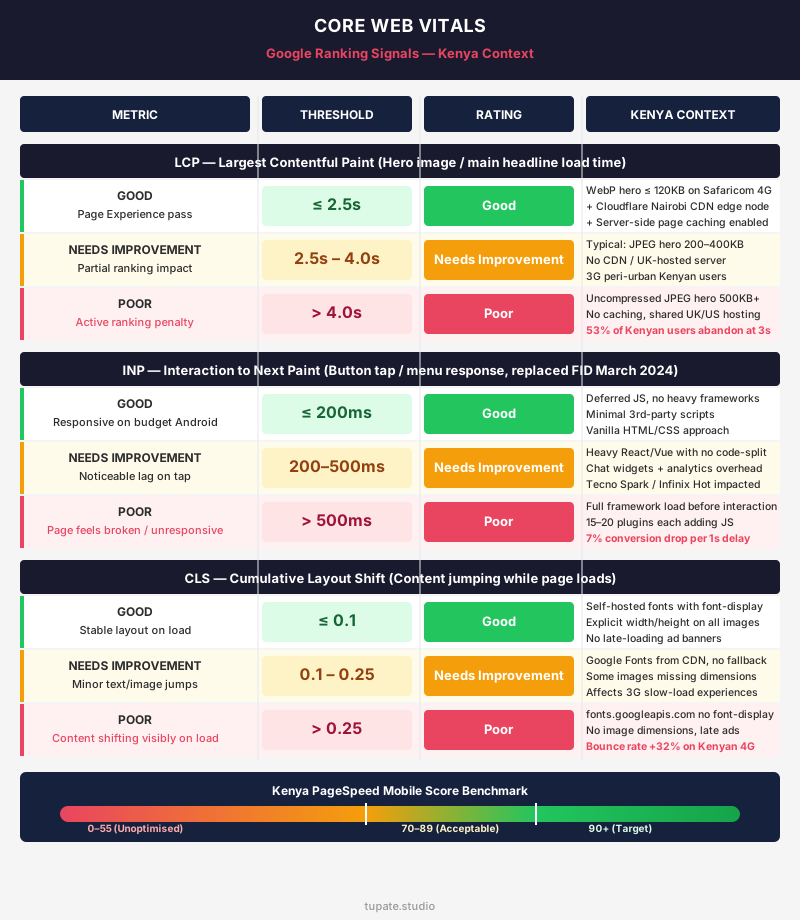
Core Web Vitals are Google's three user experience metrics that directly affect your Kenyan business website's Google rankings. Each metric measures a different dimension of how your website feels to use on a real device in Kenya, and each has a specific pass/fail threshold that Google uses to classify your site as "Good," "Needs Improvement," or "Poor." You can check your scores on a mobile-first website design Kenya basis using Google PageSpeed Insights at pagespeed.web.dev.
LCP (Largest Contentful Paint) measures how long it takes for the largest element on your page, typically your hero image or main headline, to appear on screen. Google's "Good" threshold is under 2.5 seconds.
For Kenyan business websites, uncompressed JPEG hero images are the single most common LCP failure: a 500KB+ JPEG hero image served to a Safaricom 4G connection takes 3–6 seconds to load, placing your page firmly in "Poor" territory. The fix for LCP on Kenyan sites consistently involves three interventions: converting hero images to WebP format (reducing size by 25–35%), enabling server-side page caching so the HTML reaches the browser faster, and configuring a CDN with an African edge node so the file travels less physical distance to reach your Kenyan visitor.
INP (Interaction to Next Paint) replaced FID (First Input Delay) in March 2024 and measures how quickly your page responds when a Kenyan user taps a button, opens a menu, or clicks a link on their phone. Google's target is under 200 milliseconds.
The primary cause of high INP on Kenyan business websites is heavy JavaScript loaded without code-splitting, React or Vue applications that load the entire framework before allowing any interaction will fail INP on budget Android devices like the Tecno Spark or Infinix Hot series. The fix is deferring non-critical JavaScript execution and minimising third-party scripts (chat widgets, analytics, social media embeds) that each add their own execution overhead to your page.
CLS (Cumulative Layout Shift) measures how much your page content jumps around as images, ads, and custom fonts load after the initial HTML appears. Google's "Good" threshold is a CLS score under 0.1. On Kenyan business websites, the most common CLS cause is loading Google Fonts from fonts.googleapis.com without a font-display setting, the browser renders your page with a system font first, then the custom font loads and shifts all the text position, registering as a layout shift.
The fix is self-hosting your fonts on the same server as your website and specifying explicit width and height attributes on all images so the browser reserves the correct space before the image downloads. Tupate Studio resolves Core Web Vitals failures on Kenyan business websites as part of our speed optimisation service.
Image Optimisation for Fast Loading on Kenya's Mobile Networks
Image optimisation is the highest-impact single intervention for most Kenyan business websites, the majority of page weight on a typical unoptimised Kenyan site comes from images, and the majority of that weight is unnecessary. Implementing the correct image stack reduces page weight by 60–80% in most cases, producing immediate measurable improvements to LCP scores and overall load time on Safaricom 4G and Airtel Kenya networks.
WebP is the mandatory format for all images on Kenyan business websites. WebP delivers 25–35% smaller file sizes than JPEG at the same visual quality, directly reducing the mobile data cost for every Kenyan visitor. AVIF, a newer format, achieves a further 20% reduction over WebP and is supported by Chrome, the browser used by the majority of Kenyan mobile users via Android.
JPEG and PNG should only be retained as fallback formats for the small percentage of Kenyan users on older browsers. The size targets for images on a Kenyan business website are: hero images maximum 120KB in WebP format; body content images maximum 60KB; thumbnail images maximum 20KB.
The practical impact of these targets is significant. A Nairobi restaurant website with 8 food and ambiance photos at an average uncompressed JPEG size of 525KB per image carries a total image weight of 4.2MB.
Converting all 8 images to properly sized WebP format reduces the total to 0.8MB, an 81% reduction. On Safaricom 4G, this change alone drops page load time from 8.4 seconds to 2.1 seconds: the difference between a guaranteed bounce and a user who stays to explore the menu.
Free compression tools that work for Kenyan developers and business owners include Squoosh (squoosh.app, free browser-based WebP conversion with quality control) and ImageOptim. For automated image optimisation at the infrastructure level, Cloudflare Image Resizing handles format conversion and size serving automatically. Lazy loading, adding the loading="lazy" attribute to image HTML tags, defers off-screen images from loading until the Kenyan user scrolls to them, reducing the initial page payload from the first byte.
The srcset attribute serves different image sizes to different screen widths: a Tecno Spark with a 720px-wide screen receives a 400px-wide image rather than the 1,200px desktop version, eliminating the 65% of excess pixels and data that would otherwise be downloaded and immediately discarded by the device. Finally, descriptive file names ("/nairobi-restaurant-dining.webp") replace camera default names ("/DSC00234.jpg"), both for SEO alt text alignment and for professional image asset management. Tupate Studio applies the full image optimisation stack to every Kenyan business website we build or optimise.
Caching and CDN Setup for Kenyan Business Websites
Caching and CDN (Content Delivery Network) configuration are the infrastructure-level speed interventions that reduce load time for every Kenyan visitor, including returning visitors and first-time visitors from different parts of Kenya. Together, these two configurations can reduce effective page load time by 50–70% without changing a single line of your website's code.
Browser caching instructs your Kenyan visitors' browsers to store your website's CSS files, JavaScript files, and images locally after the first visit. On return visits, or when the visitor navigates between pages on your site, these assets load from local storage rather than re-downloading from the server, making page transitions appear instant.
Implementation requires Cache-Control response headers set on the server: static assets (CSS, JS, images) should be cached for 1 year, while HTML pages should be cached for 24 hours to allow content updates to appear to returning Kenyan visitors promptly.
Server-side caching pre-renders your HTML pages and stores the rendered output, so the server does not regenerate the page from a database query every time a Kenyan visitor requests it. For WordPress-based websites, plugins including WP Rocket, W3 Total Cache, and WP Super Cache handle this.
For Tupate Studio's custom-built websites, server-level caching via Nginx FastCGI or Varnish delivers faster response with fewer failure points than plugin-based solutions.
A CDN distributes copies of your website's static assets across multiple servers globally, and for Kenyan business websites, the presence of African edge nodes is the critical specification. Cloudflare's free tier is adequate for most Kenyan business websites and has maintained edge nodes in Nairobi and Mombasa since 2024, with an additional node in Johannesburg. Serving your CSS, JavaScript, and images from a Nairobi Cloudflare node instead of a UK or US origin server reduces Time to First Byte (TTFB) from 400–800 milliseconds to 50–120 milliseconds for Kenyan visitors, a 6–10x improvement in server response speed without changing your website's code.
BunnyCDN offers a paid tier from $1/month with a Nairobi Point of Presence (PoP) that performs faster than Cloudflare's free tier for Kenyan traffic, and is cost-effective for high-traffic Kenyan business websites. Tupate Studio configures Cloudflare and CDN setup as a standard component of every website speed optimisation engagement.
Hosting Quality: How Your Kenyan Web Host Affects Your Google Score
Your web hosting provider determines your website's Time to First Byte (TTFB), the time from when a Kenyan visitor's browser requests your page to when it receives the first byte of data from your server. TTFB is the foundational metric that all other performance improvements build on: even perfectly optimised images and JavaScript cannot compensate for a server that takes 1,500 milliseconds to respond.
Google PageSpeed Insights flags any TTFB above 600ms as a server response time issue. See our web hosting Kenya page for full hosting provider comparisons and recommendations.
TTFB targets for Kenyan business websites are: under 600ms for a "Good" Google rating, under 200ms for excellent performance. Measured TTFB from Kenyan users varies significantly by hosting choice. Truehost Kenya shared hosting delivers 200–600ms TTFB for Kenyan users, acceptable for standard business websites. Kenya Website Experts delivers 300–700ms TTFB, adequate but with variability during peak traffic periods.
International shared hosting on UK, US, or Indian servers delivers 800–2,000ms TTFB to Kenyan users, unacceptably slow and a direct ranking disadvantage in Kenya SERPs. A VPS with a Nairobi data centre delivers 100–300ms TTFB, the recommended baseline for business-critical Kenyan websites. Pairing Cloudflare's free tier with any international host reduces effective TTFB for cached content to 50–200ms for Kenyan visitors.
Hosting plan type should match your Kenyan website's traffic level and technical requirements. Shared hosting is adequate for Kenyan business websites receiving fewer than 1,000 daily visitors and not running resource-intensive operations. VPS hosting is recommended for Kenyan e-commerce websites, booking platforms, and any site receiving over 1,000 daily visitors.
Cloud hosting, particularly AWS ap-southeast with Cloudflare, or Google Cloud africa-south1 (Johannesburg region, which provides the lowest latency to Kenyan users of any major cloud provider), is appropriate for high-traffic Kenyan applications requiring scalability and uptime guarantees. Tupate Studio's standard recommendation for Kenyan business websites is pairing Cloudflare's free tier with a quality local VPS or a South African VPS for the optimal balance of performance and cost.
JavaScript and CSS Optimisation for Faster Kenyan Websites
Code-level optimisation, reducing the size and render-blocking impact of your JavaScript and CSS files, is the deepest layer of website speed work and the layer where Tupate Studio's custom-built websites carry an inherent structural advantage over WordPress and plugin-based sites. For Kenyan business websites where every kilobyte translates directly to load time on mobile data, eliminating unnecessary code is as important as compressing images.
Minification removes whitespace, comments, and unnecessary characters from CSS and JavaScript files without changing their function. A 120KB unminified CSS file typically compresses to 85–100KB after minification, a 15–30% reduction achieved automatically with build tools.
Deferred and async JavaScript loading prevents render-blocking: scripts marked with the defer attribute load after the page HTML is parsed, meaning your Kenyan visitor sees the page content before JavaScript finishes loading rather than staring at a blank screen while scripts execute. Async scripts load in parallel with HTML parsing, use async for analytics and tracking scripts that do not need to run in a specific order.
Unused JavaScript elimination is the highest-impact code optimisation for WordPress-based Kenyan websites. A typical WordPress installation with 15–20 plugins loads JavaScript from jQuery, Slick Slider, WooCommerce, contact form scripts, and multiple plugin UI libraries on every page, including pages where those features are not used.
This adds 200–500KB of unnecessary JavaScript that the Kenyan visitor's Tecno or Infinix device must download, parse, and compile before the page is interactive. CSS critical path extraction inlines the above-the-fold styles directly in the HTML head, so your page's visible layout renders immediately for Kenyan visitors before the full CSS file downloads.
Google Fonts loaded from fonts.googleapis.com require a DNS lookup, a connection, and a download from an external domain, adding 200–400ms latency for Kenyan visitors even before the font file transfers. Self-hosting fonts on your own server eliminates this penalty entirely: the font request goes to the same server as your HTML, eliminating the external DNS resolution.
Tupate Studio's custom-coded websites ship only the CSS and JavaScript that each specific page requires, no plugin conflicts, no framework overhead for features not in use, no inherited bloat from theme or template code. This architectural discipline produces page weights of 150–400KB for Tupate Studio custom sites versus the 1.5–4MB typical of WordPress sites with standard themes and plugins, an inherent speed advantage for Kenyan mobile users that no amount of plugin-based optimisation can fully replicate.
Website speed is one pillar of technical website health, but Google evaluates many more factors when deciding whether to rank a Kenyan business website. A full technical SEO audit examines crawlability, indexation errors, schema markup validity, redirect chains, duplicate content signals, and mobile usability, all of which can suppress your rankings even if your website loads in 1.5 seconds.
Our technical SEO audit Kenya service covers the complete technical health check for Kenyan business websites beyond speed alone, identifying every technical factor that may be limiting your Google.co.ke visibility.
Website Speed: Custom-Built Sites vs WordPress in Kenya
The structural difference between a custom-built Tupate Studio website and a WordPress site is not a matter of visual design quality, it is a fundamental difference in code architecture that directly determines baseline performance for Kenyan mobile users before any optimisation work begins.
A standard WordPress website with a commercial theme and 15–20 active plugins has a total page weight of 1.5–4MB, TTFB of 300–800ms on Kenyan shared hosting, and an LCP time of 3–6 seconds on Kenyan 4G, placing it in the "Poor" Core Web Vitals range. This is before any content images or custom code is added.
The cause is architectural: WordPress loads the full theme stylesheet, 40–80 HTTP requests from plugin scripts and stylesheets, and jQuery (a 90KB dependency required by most plugins) on every page regardless of what that page actually uses.
Tupate Studio's custom-built websites deliver page weights of 150–400KB, TTFB of 100–300ms with CDN, and LCP consistently under 2.5 seconds on Kenyan 4G, the "Good" threshold. Each page loads only the HTML, CSS, and JavaScript it specifically requires. There are no plugin conflicts, no redundant jQuery instances, and no theme overhead.
The practical result for a Kenyan business is a website that passes Core Web Vitals from day one without requiring ongoing speed plugin management. Learn more about the full comparison in our custom-built website vs WordPress Kenya page, and see how this connects to the complete technical SEO audit Kenya service.
Testing Your Website Speed for Kenya
Testing your Kenyan business website's speed requires using tools and settings that reflect actual Kenyan user conditions, not a simulated US broadband connection. The results will be significantly different and more actionable.
Google PageSpeed Insights (pagespeed.web.dev) is the primary tool: always test the mobile score, not the desktop score, the mobile score reflects how your site performs for Kenyan smartphone users and is the score Google uses for its rankings assessment. GTmetrix allows you to select "Nairobi, Kenya" as your test server location, giving latency results that reflect actual Kenyan network conditions rather than US or European server proximity. Google Search Console's Core Web Vitals report shows real-world field data from your actual Kenyan visitors, this is more accurate than any lab test for established websites with existing traffic. WebPageTest (webpagetest.org) provides the most granular testing: select "Chrome on Android, Moto G4" as the device profile and "4G" as the connection type for the most Kenya-realistic simulation of a budget Android device on Safaricom 4G.
A score of 90 or above on Google PageSpeed mobile is the target for Kenyan business websites competing for any moderately competitive keyword. Most unoptimised Kenyan business websites score 30–55 on mobile before optimisation, a range that represents an active ranking disadvantage in Google.co.ke. WhatsApp us with your score and we will provide a free assessment of your optimisation priorities.
Frequently Asked Questions
What is a good Google PageSpeed score for a Kenyan business website?
90 or above is excellent and gives you a ranking advantage over competitors in Kenya SERPs. 70–89 is acceptable but leaves performance on the table. Below 70 means you are actively losing Google rankings and Kenyan customers, especially on mobile. Most Kenyan business websites score 30–55 before speed optimisation. Contact Tupate Studio for a free PageSpeed assessment of your site.
How long does website speed optimisation take?
Basic optimisations, image compression, browser caching setup, CDN configuration, can be completed in 3–5 business days for a standard Kenyan business website. Core Web Vitals improvements requiring code changes (JavaScript deferral, critical CSS extraction, font self-hosting) take 1–2 weeks for a complete implementation. We provide a timeline estimate after an initial site audit.
Will speeding up my website improve my Google rankings in Kenya?
Core Web Vitals (LCP, INP, CLS) are confirmed Google ranking signals. Improving from a "Poor" to "Good" rating removes an active ranking penalty for your Kenyan business website. It will not override weak content or a missing backlink profile, but it eliminates a significant technical disadvantage that is suppressing your Google.co.ke visibility right now.
My website is on cheap Kenyan hosting and it is slow, what should I do?
The fastest fix is adding Cloudflare's free tier, a DNS change that takes 15 minutes and can reduce effective TTFB for Kenyan visitors by 60–70% for cached content. Long-term, migrating to a VPS with a Nairobi or Johannesburg data centre improves raw TTFB by 60–80% compared to UK or US shared hosting. Tupate Studio handles both Cloudflare setup and hosting migration for Kenyan business websites, call us today for a quote.