Content marketing is the strategy of publishing valuable educational content that attracts Kenyan customers at the moment they are researching a problem your business solves. A Nairobi dental clinic that publishes a comprehensive guide to "teeth whitening options in Kenya with prices" attracts Kenyans considering the procedure, before they have a dentist in mind.
That guide earns organic Google traffic, builds expertise, and converts readers into booked appointments. For businesses ready to go further, Kenya SEO structures this content for maximum search engine visibility.
Content marketing works by turning your business expertise into assets that attract Kenyan customers continuously, long after the content is published.
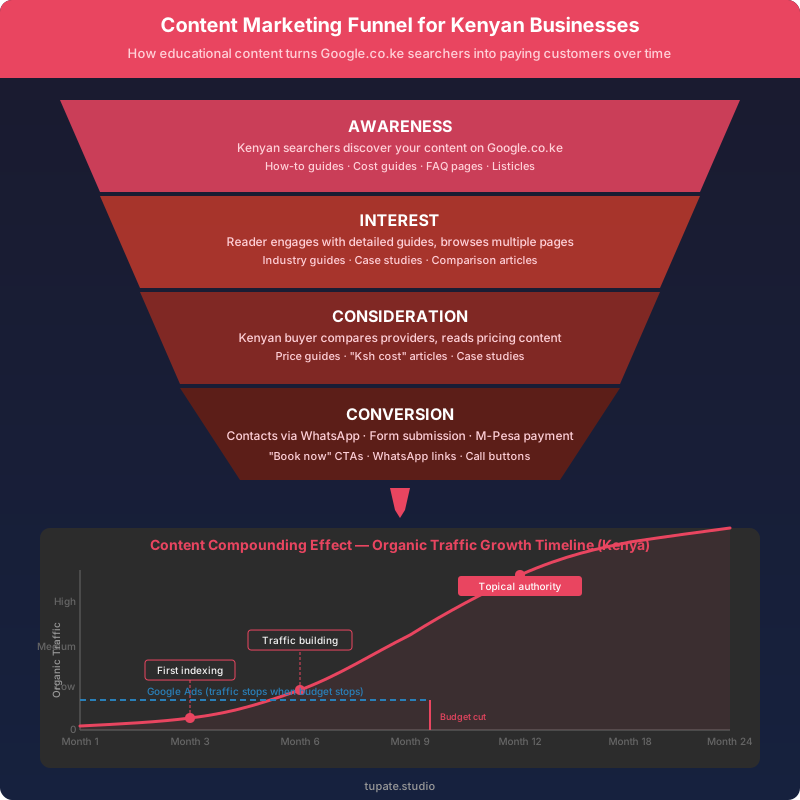
The mechanism is straightforward: you create valuable content that answers questions Kenyans are already typing into Google.co.ke, those pages earn organic rankings, and visitors arrive at your website already interested in what you offer. Unlike a cold call or a paid banner ad, someone reading your "Guide to Commercial Generator Installation in Nairobi" has already identified themselves as a buyer at the research stage.
Kenyan businesses benefit from content marketing for three specific reasons that are unique to this market. First, most Kenyan competitors have thin or no blog content, the bar for ranking on informational keywords is significantly lower in Kenya than in the UK or US. Second, Kenyan customers who are considering high-value purchases, legal services, construction, medical procedures, technology solutions, research extensively online before contacting a provider.
The business whose educational content they find first earns the call. Third, educational content captures early-stage Kenyan buyers who have not yet chosen a provider, giving you the opportunity to demonstrate expertise before competitors are even in the conversation.
Content marketing contrasts with advertising in one critical way: advertising rents traffic. Stop paying for Google Ads or Facebook Ads and your traffic stops immediately. Content marketing builds owned assets.
A well-optimised article on your website continues attracting Kenyan visitors from Google organic search even if you stop publishing, the published content keeps working. This compounding effect is why businesses that commit to content for 9–12 months consistently see traffic that advertising budgets cannot sustain.
For timeline expectations in Kenya: first content pieces are typically indexed by Google within 2–6 weeks of publication on an established website. Meaningful traffic growth from individual articles builds over 3–6 months as the pages accumulate impressions and clicks.
Topical authority, the state where Google consistently prefers your site for an entire topic cluster, is demonstrated by month 9–12 of consistent publishing.
The content formats that drive the most organic traffic for Kenyan businesses are how-to guides, cost guides, and FAQ pages, all targeting queries Kenyans are actively searching.
How-to guides dominate Kenyan informational search because they match the query pattern Kenyans use when researching a process: "How to register a company in Kenya," "how to clean solar panels at home Kenya," "how to apply for a work permit in Kenya." These guides carry high search volume, educational intent, and position your business as the authority on the procedure, especially relevant for legal, accounting, and technical service businesses in Nairobi.
Industry guides targeting procurement managers and B2B buyers are high-value for industrial, manufacturing, and professional services companies. A guide titled "Industrial Equipment Maintenance Schedule for Kenyan Factories" targets procurement and operations managers at exactly the stage when they are evaluating service providers, before they have issued a tender.
Cost and price guides are among the highest-converting content formats in Kenya. Queries like "website design cost in Kenya," "dental implants price Nairobi," "cost of solar installation Kenya 100 units" carry strong commercial intent.
Kenyan buyers are price-sensitive and compare providers, being the authoritative source on pricing positions your business as transparent and trustworthy.
Case studies convert late-stage Kenyan buyers who are nearly ready to purchase: "How a Westlands Law Firm Increased Client Enquiries by 60% with a New Website" provides a peer-relevant proof point that removes hesitation. FAQ pages target question-format queries and earn FAQ rich results in Google.co.ke, these doubled-entry results increase click-through rate significantly for Kenyan businesses.
Comparison content ("WooCommerce vs Shopify for Kenyan Businesses") captures commercial-intent comparative queries. Listicles ("10 Best Accounting Software for Kenyan SMEs") distribute widely via WhatsApp and LinkedIn Kenya and earn consistent organic traffic from broad informational queries.
What to avoid: thin news reposts with no Kenyan-specific analysis, purely promotional "company news" posts that no Kenyan outside your office will search for, and content that lacks Kenya-specific context (a generic "How to Start a Business" article adds no value in competition with fully Kenya-specific guides).
The right choice between in-house and outsourced content writing for Kenyan businesses depends on whether the business owner has genuine subject matter expertise and available time, not just budget.
In-house content writing, where the business owner or a staff member writes the content, has a specific advantage that no outsourced writer can replicate: authentic Kenyan industry knowledge. A Nairobi immigration lawyer writing about "Changes to Kenya Work Permit Categories in 2025" brings factual accuracy and genuine expertise that a freelance writer researching the same topic cannot match.
This authenticity builds authority faster. The practical disadvantages are significant, however: content writing is time-intensive, it is consistently deprioritised when client work is present, output quality varies, and without SEO training the content will attract readers but not rank on Google.
In-house writing works best for specialised professional businesses where the owner has genuine expertise and authentic knowledge of Kenya-specific nuances: a niche manufacturing operation, a specialised legal firm, a technical consulting practice. For a generalist business, the time cost of in-house writing usually outweighs the authenticity benefit.
Outsourced content writing for Kenyan businesses is widely available. Kenyan freelance writers are accessible via Upwork, LinkedIn, and Fiverr, rates range from Ksh 1–5 per word for general blog content to Ksh 5–15 per word for expert technical or professional content.
The key requirement is that all outsourced content must be reviewed by someone with genuine Kenyan industry knowledge before publication. Factual accuracy builds authority; factual errors, particularly on legal, financial, or medical topics, destroy it and can expose businesses to reputational and regulatory risk.
Tupate Studio provides SEO-optimised content as part of content strategy engagements. Our content is structured for Google rankings from the brief stage, not just readable, but architecturally designed to rank for specific Kenyan queries.
The hybrid approach works best for most Kenyan businesses: you provide the raw industry expertise and Kenya-specific facts, we structure and optimise for search. WhatsApp us to discuss your content needs.
Content distribution for Kenyan businesses must prioritise organic search as the primary channel, with WhatsApp broadcast as the highest-read secondary channel, because content that is never distributed never compounds.
Organic search via Google.co.ke is the primary distribution channel for Kenyan content marketing, it is the compounding, long-term mechanism. A well-optimised article attracting 200 Kenyan visitors per month in year one attracts 600 in year three if maintained. No other channel provides this compounding return without continuous spend.
LinkedIn Kenya is the most effective platform for B2B content distribution. Reposting article summaries from your website blog reaches Kenyan professionals in manufacturing, finance, healthcare, and technology industries.
LinkedIn articles rank independently in Google for professional queries and extend your content's organic reach beyond your website alone.
WhatsApp broadcast is the highest-read distribution channel for Kenyan audiences. The open rate for WhatsApp broadcast messages to opted-in subscribers exceeds email open rates by a significant margin in Kenya, a new educational guide shared to a 300-person WhatsApp broadcast list generates immediate high-quality traffic.
Building and maintaining an opted-in subscriber list is one of the highest-ROI content distribution investments a Kenyan business can make.
Twitter/X Kenya has an active professional community. Thread-format reposts of article key points, "5 things Kenyan businesses get wrong about their website (from our latest guide)", drive traffic effectively when published during Nairobi business hours.
Facebook Kenya remains the largest social platform by user count for B2C content and reaches the mass consumer audience that B2C Kenyan businesses need.
Email newsletters work well for Kenyan businesses with existing customer lists. A monthly digest of new educational content maintains top-of-mind presence with past and prospective clients.
The distribution rule for Kenyan content marketing: spend 30% of available time creating content, 70% distributing it. The most common failure pattern in Kenya is excellent content published to an empty room.
Connect content marketing to your Kenya SEO strategy
Content marketing is SEO in its content dimension. Each piece of educational content targets specific Kenyan search queries, builds topical authority, and earns organic traffic.
Our content strategy for Kenyan websites service provides the SEO architecture that turns your content marketing investment into measurable rankings. Get a free quote.
WhatsApp us →Frequently Asked Questions About Content Marketing for Kenyan Businesses
How much does content marketing cost for a Kenyan business?
DIY content marketing, where the business owner writes the content, costs only time. Outsourced blog posts from Kenyan SEO-optimised content writers typically cost Ksh 3,000–8,000 per 1,500-word article, depending on topic complexity and writer expertise. Tupate Studio's content strategy service (content planning, SEO briefs, editorial review, and publication structure) starts from Ksh 8,000 per month, the same price as our SEO retainer, because content strategy and SEO are inseparable for Kenyan businesses targeting Google organic rankings.
How long before content marketing generates results for a Kenyan business?
First content pieces appear in Google's index within 2–6 weeks of publication on a properly set-up Kenyan business website. Traffic from individual articles typically builds over 3–12 months as Google accumulates data on engagement with those pages. Businesses that publish consistently for 9–12 months see compounding organic traffic growth, each new article adds to the accumulated base, and older articles strengthen as they gather more clicks and engagement from Kenyan searchers. Businesses that stop after 3 months rarely see results; businesses that commit for 12 months almost always do.
Does a Kenyan B2B business need a blog?
Most Kenyan B2B businesses benefit more from 3–5 deep educational guides (1,500–3,000 words each) than from 20 shallow blog posts. Depth matters more than frequency in Kenyan B2B content marketing. An industrial equipment company with 4 comprehensive buying guides, covering specifications, Kenyan pricing, maintenance costs, and supplier comparison, will outperform a competitor with 50 thin 300-word news posts. For B2B, quality and depth signal expertise to both Kenyan procurement managers and Google's ranking systems. WhatsApp us to discuss the right content structure for your B2B sector.