Kenyan consumers discover brands on Instagram, research products on Facebook, get recommendations in WhatsApp groups, and watch tutorials on TikTok. But they convert, they buy, book, or inquire, on your website.
Social media marketing for Kenyan businesses is most effective when it functions as a traffic source and awareness channel, with the website as the destination that completes the sale.
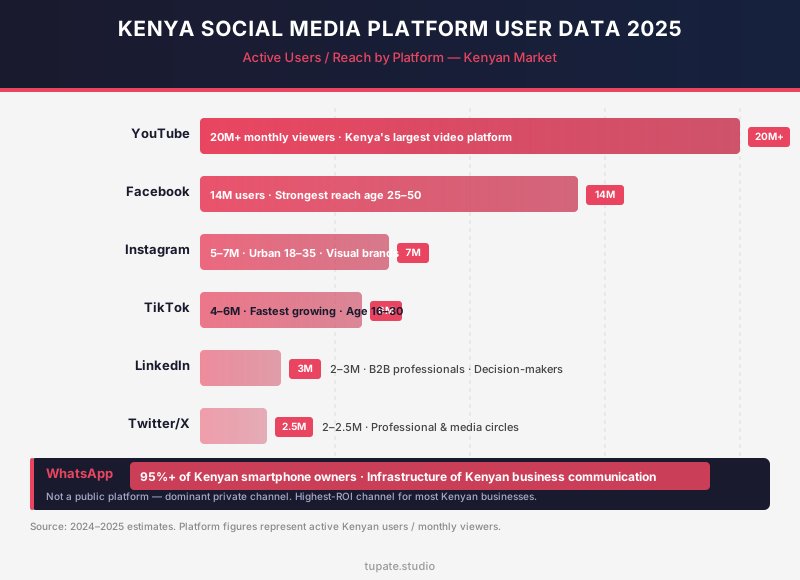
Kenya's social media landscape in 2025 is led by Facebook's 14 million users, followed by Instagram, TikTok, and YouTube, with WhatsApp reaching 95%+ of Kenyan smartphone owners as the dominant private communication channel.
Choosing the right social media platforms for your Kenyan business begins with understanding where Kenyan audiences actually are, not where global marketing trends suggest you should be. The Kenyan social media landscape has distinct characteristics shaped by the country's mobile-first internet adoption, demographic structure, and cultural communication preferences.
Facebook remains the broadest-reach social platform in Kenya, with 12 to 14 million Kenyan users as of 2024–2025 estimates. Facebook's core strength in Kenya is the 25–50 age group, economically active Kenyan adults with purchasing power across B2C and B2B categories.
Facebook Groups are a particularly powerful distribution channel in Kenya: community-based groups for specific neighbourhoods, business sectors, and interest categories function as trusted peer recommendation networks. A recommendation in a trusted Nairobi business owners' Facebook Group carries commercial weight that paid advertising cannot replicate.
Instagram has 5 to 7 million Kenyan users and is concentrated in the 18–35 urban demographic. It is the primary platform for visually-driven Kenyan businesses: fashion and clothing, food and restaurants, interior design and furniture, fitness studios, beauty and cosmetics, and travel.
If your product or service benefits from professional photography and aspirational visual presentation, Instagram is a priority channel. Reels (short-form video) significantly outperforms static image posts in Kenyan Instagram algorithm reach as of 2024–2025.
TikTok has 4 to 6 million Kenyan users and is growing faster than any other platform in Kenya. Its core demographic is 16–30, and its content format, short, entertaining, authentic video, rewards businesses willing to demonstrate products and services in action rather than simply advertise them.
TikTok has proven particularly effective in Kenya for food businesses, fashion retailers, beauty services, and any business with a visible product or process. The platform's algorithm rewards content quality over follower count, meaning a Kenyan SME with zero followers can go viral with a compelling 30-second product demonstration.
LinkedIn has 2 to 3 million Kenyan professionals and is the unambiguous priority platform for B2B services marketing, corporate consulting, legal services, accounting and tax advisory, HR services, IT and technology, and financial products targeting Kenyan business decision-makers. Twitter/X maintains 2 to 2.5 million active Kenyan users concentrated in professional and media circles, useful for brand commentary and customer service visibility.
YouTube commands over 20 million monthly Kenyan viewers, making it Kenya's largest video platform and the country's second-largest search engine, a strategic channel for any Kenyan business that can produce educational or demonstrative video content consistently.
WhatsApp occupies a unique position. With over 95% of Kenyan smartphone owners using it, WhatsApp is not a public social media platform in the conventional sense, it is the infrastructure of Kenyan personal and business communication.
Industrial businesses, professional services firms, and B2B companies that find limited value in public social media platforms will almost universally find that WhatsApp is the highest-ROI digital channel available to them.
Platform selection rule for Kenyan businesses: choose one to two platforms your Kenyan customers actually use, and execute consistently. B2C physical products perform best on Instagram, TikTok, and Facebook. B2B professional services perform best on LinkedIn, Facebook, and organic Google (where Tupate Studio's SEO services deliver long-term ROI).
Restaurants and hospitality brands should prioritise Instagram and TikTok with food photography. Industrial and manufacturing businesses typically find SEO and LinkedIn more commercially productive than consumer social platforms.
Integrating social media with your Kenyan business website requires Open Graph tags, pixel tracking, a WhatsApp click-to-chat button, and social proof display, technical implementations that Tupate Studio builds into every website.
Social media platforms and your business website must function as a connected system, not separate presences. The connection is built through specific technical integrations that allow social media content to drive qualified traffic to your website and enable your website to build retargeting audiences from its visitors, dramatically improving the efficiency of your social media advertising.
Social media profile links in the website header or footer establish the foundational connection. Every active social platform your Kenyan business maintains should be linked from the website, this builds cross-platform discovery (a Kenyan customer visiting the website can follow on Instagram), signals to Google that the website and social profiles are the same entity (entity consolidation in search), and demonstrates active brand management that Kenyan B2B buyers value in supplier assessment.
Open Graph tags are HTML meta tags in the website's code that control exactly how your pages appear when Kenyan customers share them on Facebook, LinkedIn, and WhatsApp, the title displayed, the description shown, and the image that appears. Without Open Graph tags, Facebook and WhatsApp choose content arbitrarily when a page link is shared, often producing an unattractive or irrelevant preview that reduces click-through rates.
Tupate Studio implements Open Graph meta tags on all website builds as standard, ensuring every shared link from your website presents professionally on Kenyan social feeds.
Pixel and tracking tag integration is the commercial backbone of social media advertising for Kenyan businesses. The Facebook Pixel (Meta Pixel), TikTok Pixel, and LinkedIn Insight Tag are small JavaScript snippets installed on your website that track visitor actions, page views, form submissions, product views, purchases.
This tracking enables two powerful advertising capabilities: conversion tracking (knowing precisely which Facebook or TikTok ad led to a Kenyan customer inquiry or purchase) and retargeting (serving ads specifically to Kenyan users who visited your website but did not convert). Retargeting audiences are typically three to five times more likely to convert than cold audiences, making pixel-tracked retargeting one of the highest-ROAS social advertising strategies available to Kenyan SMEs.
The WhatsApp Business click-to-chat button using a wa.me link is, without qualification, the single highest-conversion website integration for Kenyan business websites across almost every industry. Kenyan customers are conditioned to communicate via WhatsApp, a prominent WhatsApp button on every page of the website reduces the friction between website visit and customer inquiry to a single tap.
Tupate Studio positions the WhatsApp button as a floating action button visible on mobile devices throughout the browsing session, capturing inquiry intent at every point in the customer journey.
Social proof integration, displaying an embedded Instagram feed, Facebook Reviews widget, or Google Reviews on the website, adds live, authentic content that communicates active brand presence and customer satisfaction to Kenyan website visitors. For Kenyan B2C businesses where peer trust is a primary purchase driver, visible social proof on the website directly increases inquiry conversion rates.
Share buttons on blog content and service pages enable easy one-tap sharing to Kenyan WhatsApp groups and Facebook Groups, organic distribution channels with far higher trust levels than paid advertising.
Social media advertising in Kenya reaches Facebook/Instagram audiences from Ksh 50–200 CPM, TikTok from Ksh 5,000/month minimum, and LinkedIn at higher cost-per-click, with website conversion objectives and dedicated landing pages delivering the highest return.
Social media advertising in Kenya offers access to large, targetable Kenyan audiences at cost-per-impression rates significantly lower than equivalent campaigns in US, UK, or European markets. Facebook and Instagram Ads (managed through Meta Business Suite) are the dominant social advertising channel for Kenyan B2C businesses.
Kenya-specific targeting options include country-level, city-level (Nairobi, Mombasa, Kisumu, Nakuru), and radius-based geographic targeting; interest categories relevant to Kenyan audiences; age and gender demographics; and custom audiences based on existing customer data or website pixel activity.
Cost-per-thousand impressions (CPM) for Kenyan audiences ranges from Ksh 50 to Ksh 200 depending on audience competitiveness and ad quality score. Cost-per-click (CPC) ranges from Ksh 15 to Ksh 80. The most effective ad formats in Kenya in 2024–2025 are Reels-format video ads (appearing in Instagram and Facebook Reels feeds) and lead generation ads, the latter collecting Kenyan customer contact details without requiring the user to leave Facebook, which significantly reduces friction and increases lead volume.
A minimum effective testing budget for Facebook/Instagram ads in Kenya is Ksh 5,000 to Ksh 10,000 per month. Direct Kenyan ad traffic to a dedicated landing page design Kenya built for conversion, not the homepage.
TikTok Ads for Kenya use In-Feed video ads that appear in users' For You Page. Video format is mandatory; static image ads are not supported. TikTok advertising in Kenya is most productive for fashion, food, beauty, fitness, entertainment, and youth-oriented consumer products.
The minimum meaningful budget for TikTok advertising in Kenya is Ksh 5,000 to Ksh 15,000 per month. Creative quality, how engaging and authentic the video ad feels, determines performance far more than budget size on TikTok.
LinkedIn Ads for Kenya are the most expensive social advertising option but target a unique audience unavailable on other platforms: Kenyan corporate decision-makers, senior professionals, and business leaders. LinkedIn's minimum daily ad spend is approximately USD 10 (around Ksh 1,300), with CPCs significantly higher than Facebook or Instagram.
LinkedIn Lead Gen Forms, which allow Kenyan LinkedIn members to submit their professional contact details without leaving LinkedIn, are the highest-converting ad format for B2B services targeting Kenyan companies.
Objective selection is the most commonly mismanaged element of social media advertising by Kenyan businesses. Running awareness objectives when the business goal is customer inquiries is a budget waste.
Set website traffic or conversion objectives when running campaigns, and ensure the Facebook Pixel or equivalent tracking tag is correctly installed so the platform can optimise delivery toward users most likely to convert.
WhatsApp Business is Kenya's most effective direct marketing channel, with the free app serving SMEs via broadcast lists and the API enabling automated sequences and CRM integration at scale.
WhatsApp occupies a position in Kenyan business marketing that has no direct equivalent in other markets. WhatsApp Business (the free mobile application) is the appropriate tool for Kenyan SMEs managing up to several hundred active customer contacts.
The business profile allows entry of company description, operational hours, website link, product or service catalogue, and physical address, creating a structured business identity within the WhatsApp environment. Broadcast lists allow sending a single message to up to 256 opted-in contacts simultaneously, effective for announcing new products, promotional offers, or service updates to engaged existing customers without the per-message cost of SMS.
Quick reply templates, automated greeting and away messages, and conversation labels for pipeline management (New Inquiry, Quoted, Closed Won, Follow-up Required) turn WhatsApp into a lightweight but functional sales management tool.
WhatsApp Business API (accessed through Meta Business Suite or Kenyan Business Solution Providers) enables operations at a scale beyond the free app's constraints. It supports automated message sequences, for example, an automatic order confirmation followed by a delivery update, CRM integration with platforms like HubSpot, Zoho, or custom-built Kenyan systems, WhatsApp chatbot implementation for handling common Kenyan customer inquiries around the clock, and compliant bulk messaging to large opt-in subscriber lists.
The website integration for WhatsApp is straightforward and high-impact: a wa.me click-to-chat link button prominently displayed on every page. Clicking this button opens a WhatsApp conversation with the business pre-populated with a customisable opening message, reducing the inquiry barrier to a single tap for any Kenyan mobile user.
Content sent through WhatsApp broadcast lists should be limited to one to two messages per week maximum; over-messaging drives opt-outs that permanently remove customers from your broadcast reach.
Measuring social media marketing ROI for Kenyan businesses requires GA4 traffic source analysis, conversion rate comparison by channel, and data-driven attribution, not follower counts or likes.
The greatest challenge in social media marketing measurement for Kenyan businesses is the indirect contribution of social media to conversions. In Google Analytics 4, the Traffic Source report allows you to view the volume, engagement rate, and conversion rate of sessions originating from each social platform.
For Kenyan businesses, compare social traffic conversion rates against organic search conversion rates, if social traffic converts at 0.5% and organic at 3%, the social audience quality needs refinement, not simply higher social spending.
GA4's data-driven attribution model uses machine learning to distribute conversion credit across multiple touchpoints in a Kenyan customer's journey, providing a more accurate picture than last-click attribution. For digital marketing services Kenya clients, Tupate Studio configures GA4 attribution modelling as part of the analytics setup.
The social media metrics that indicate genuine business impact for Kenyan businesses are: website sessions from social channels; conversion rate of those sessions into WhatsApp messages, form submissions, or purchases; ad ROAS (revenue in Ksh divided by ad spend in Ksh, target a minimum of 3:1 for Kenyan social advertising to be commercially viable); and WhatsApp click volume from social profiles. Metrics that do not directly indicate business impact, follower counts, post likes, story views, shares, are vanity metrics unless they demonstrably translate into website visits or direct inquiries.
Social media content, whether organic posts or paid campaigns, is most effective when it connects to a broader content ecosystem. Publishing educational material via social media content Kenya blog posts and then repurposing it on LinkedIn and Facebook extends the reach of your content investment across both SEO and social channels simultaneously.
Social media drives traffic. Your website converts it.
Every Instagram post, every Facebook ad, every TikTok video should end with one destination: your website and social media Kenya system built to convert. Tupate Studio builds the conversion destination from Ksh 25,000 — designed specifically to convert the Kenyan customer journey.
Our online marketing services Kenya integrate social media, SEO, and Google Ads into a single acquisition system.
WhatsApp us for a free quote →Frequently Asked Questions: Social Media Marketing for Kenyan Businesses
Which social media platform is best for a Kenyan business?
The best platform depends entirely on your target audience and business type. Instagram and TikTok are most effective for visual B2C brands targeting Kenyans aged 18–35 — fashion, food, beauty, fitness, home decor. Facebook provides the broadest reach across all Kenyan age groups and is strong for community-based marketing through Kenyan Facebook Groups. LinkedIn is the priority channel for B2B professional services targeting Kenyan corporate decision-makers. WhatsApp is the most effective direct customer communication and relationship-building channel across virtually every Kenyan industry. Choose one or two platforms where your Kenyan customers are genuinely active, commit to consistent quality content for 90 days, and measure results before expanding to additional platforms.
Should I manage social media myself or hire someone for my Kenyan business?
For Kenyan SMEs starting out, two to four posts per week created by the business owner, showing behind-the-scenes processes, customer results, product demonstrations, or answering common customer questions, consistently outperforms outsourced generic content. Kenyan audiences respond strongly to authentic, specific, locally-relevant content. The business owner who knows the product, the customers, and the Kenyan market context produces more compelling content than a distant social media manager posting stock-photo designs with generic captions. Outsource social media management when you are ready to scale to systematic paid advertising, multi-platform management, and content production at volume.
How much should a Kenyan business spend on social media advertising?
Ksh 5,000 to Ksh 10,000 per month is a practical testing budget for Facebook and Instagram ads targeting Kenyan audiences. At this level, you will generate enough data within 30 days to identify which ad creative, audience, and objective combination produces WhatsApp messages or website conversions. Scale your spending only once you have identified ads that are producing leads at an acceptable cost per acquisition, not based on impressions or reach alone. Starting with a small test budget and scaling proven winners is far more efficient than committing Ksh 50,000 per month to untested creative.
Does social media help my website rank on Google in Kenya?
Social media does not directly affect Google search rankings, Google has confirmed that social media signals (likes, shares, follower counts) are not ranking factors in its algorithm. However, social media contributes to SEO performance indirectly in three ways: it drives traffic to your website (user behaviour signals that Google measures), it can generate backlinks when your content is shared and referenced by other Kenyan websites (a direct ranking factor), and it builds brand awareness that increases branded Google searches for your business name. For Kenyan businesses with limited budgets, investing in SEO before social media advertising typically produces more durable ROI because organic search rankings, once achieved, deliver free traffic continuously.